A CLOSER LOOK
Wikivoyage’s Cooch Behar guide introduces a city in northern West Bengal through its royal heritage. A useful place to begin is the palace associated with Maharaja Nripendra Narayan of the Koch dynasty. The district’s official history dates completion of the new palace to 1887.
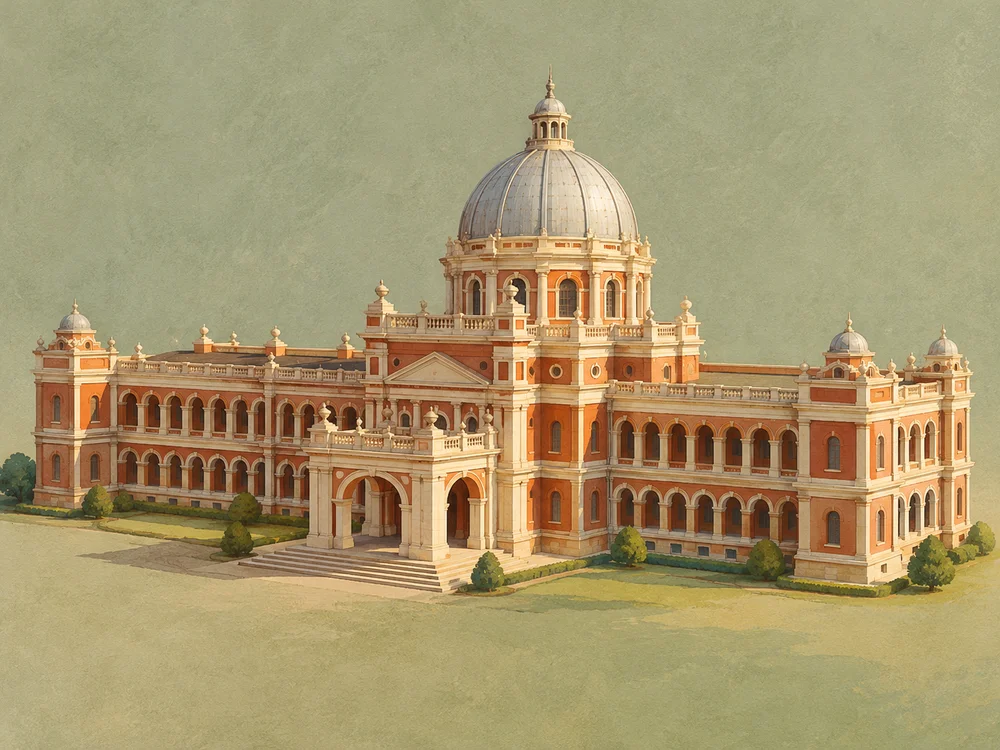
The Archaeological Survey of India’s Raiganj Circle describes a double-storey brick structure in a classical Western style. Its account places a projecting entrance porch at the center, leading to the Durbar Hall. A high metal dome rises over that hall. Those details give a reader a route through the description, from the broad building toward a marked center.
Try an original looking exercise with an official view of the palace: locate the porch, then trace the dome above it. Sketch only the outline of the central mass and the lower wings. Ask where your attention lands first. This is a proposed way of examining the composition; it does not establish the architect’s intention or the experience of every viewer.
The district history supplies a second timescale. It records transfer of the administration to the Government of India on 12 September 1949, followed by merger with West Bengal on 1 January 1950. These are distinct administrative steps. Setting them beside the 1887 completion date helps keep the palace’s construction separate from the later political transition.
A palace is one entry into the city’s history. This short account does not cover the lives of its residents or the full history of the Koch state. The official sources below support the selected dates and architectural features. The community guide remains a broader starting point; practical travel details need their own current checks.
The generated illustration is an imaginative architectural study inspired by the documented central porch and dome. Its ornament and proportions are interpretive. It is not a measured reconstruction or an image of an authentic model. Use the original heritage record for photographs when examining the real building.
Guide context adapted from Wikivoyage contributors · CC BY-SA 4.0 · Source credits · License and reuse terms