A CLOSER LOOK
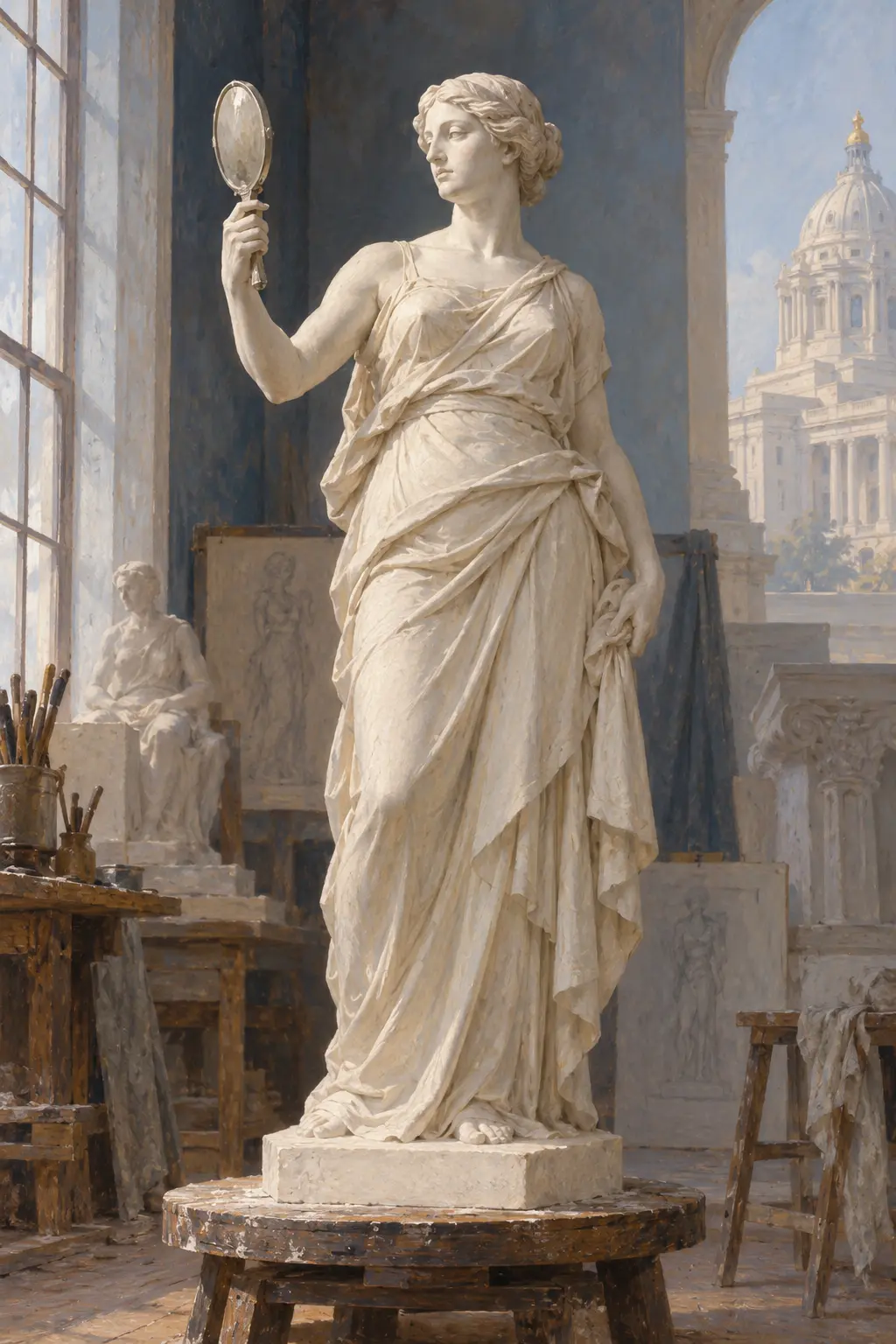
The Art Institute dates this plaster figure to 1900. French had received a commission in 1898 for six allegorical figures—Bounty, Courage, Integrity, Prudence, Truth, and Wisdom—for the Minnesota State Capitol in Saint Paul. This sculpture is a working model at half the scale of the marble Truth installed on the building, where it was paired with Integrity.
A working model translates an idea into instructions for a larger object. French established the figure’s pose and drapery in plaster before the design was carried into stone. Minnesota Historical Society documentation explains that the six colossal Virtues were carved in white marble from French’s designs and placed below the gilded Progress of the State quadriga. Their elevated architectural setting made abstract qualities part of the Capitol’s public face.
The commission also shows that a named artist’s monumental sculpture could be a distributed production. The Cass Gilbert Society records that French produced half-size models while local carvers executed the marble figures. It traces this plaster Truth from a 1918 donation in Saint Paul through later collections to the Art Institute, which acquired it in 1984. The model is therefore an autonomous museum object and evidence of a larger making process.
The marble figures now on the Capitol are replicas carved from 1975 to 1979 after the originals deteriorated outdoors. That replacement history limits what the present facade can reveal about the 1905 installation. The generated illustration on this page is an interpretive studio scene based on the cited records. It is not a photograph of the Chicago plaster or evidence for details missing from the sources.