A CLOSER LOOK
The Art Institute dates this marble bust to 1809 and records dimensions of roughly 70 centimetres high, 31 wide, and 28 deep. Canova made it for his friend Antoine Quatremère de Quincy, a French theorist and critic who influenced his ideas about classical art. It developed alongside a full-length Paris commissioned by Joséphine de Beauharnais, then Empress of France.
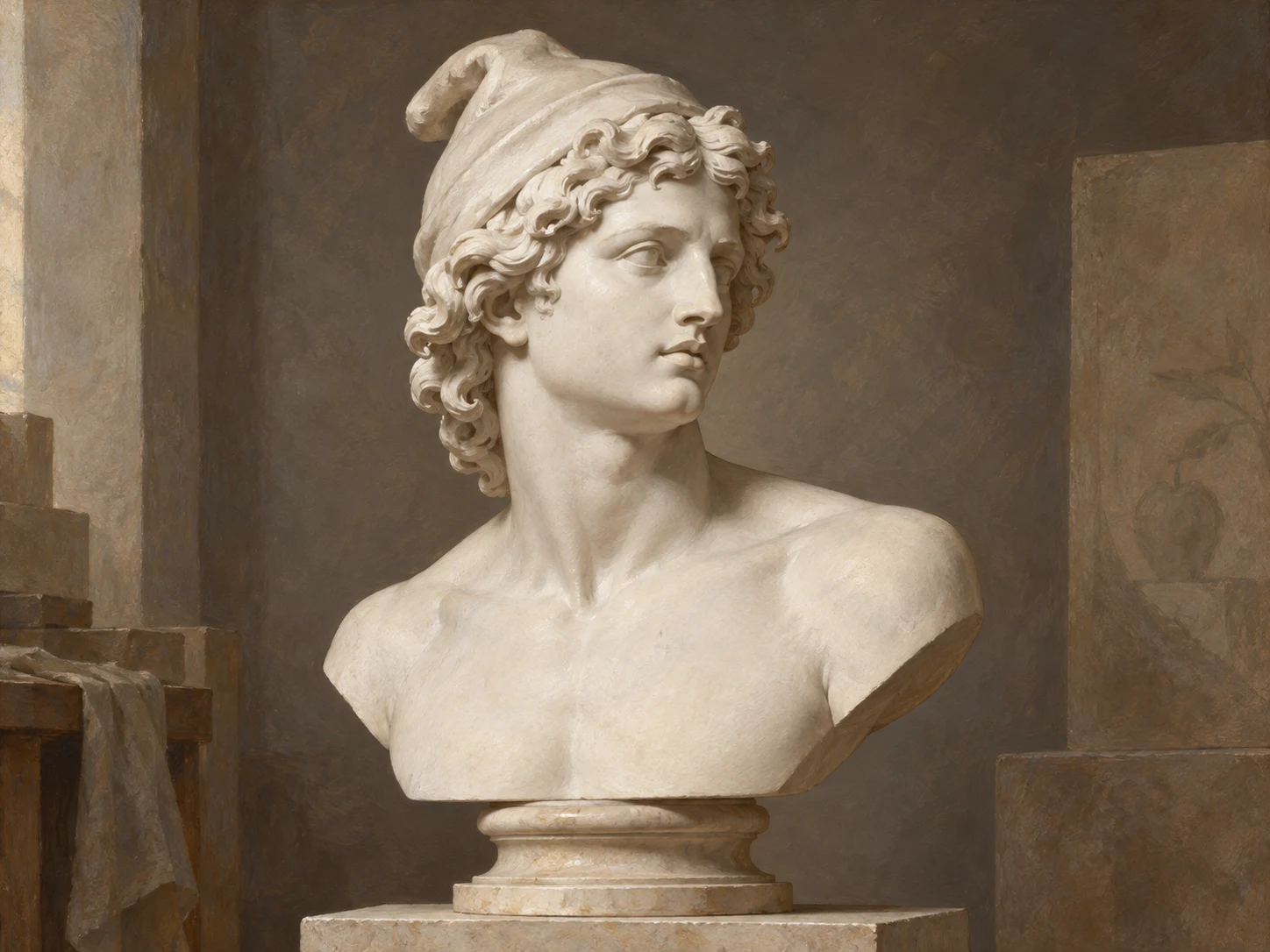
Paris is the Trojan prince asked to judge which of three goddesses is most beautiful. Canova identifies him through the soft Phrygian cap associated with his life as a shepherd. A related full-length version hides the awarded apple behind his back. Venus’s promised reward is Helen, whose departure from Sparta becomes the legendary cause of the Trojan War.
The bust removes the apple and the rest of the body, leaving the decision suspended in a turn of the head. Smooth marble, balanced features, and carefully ordered curls give Paris an ideal calm. That restraint belongs to Canova’s Neoclassical method: a familiar ancient subject is rebuilt through selective details rather than treated as an archaeological reconstruction of a historical person.
Canova and his workshop produced replicas and variants of successful subjects to answer strong demand. The Metropolitan Museum records another marble Paris made in his workshop and notes versions for Joséphine and Prince Ludwig of Bavaria. The existence of related works helps explain the model’s circulation, but it does not make every surviving Paris interchangeable. The generated illustration is an interpretive aid based on the cited records, not a view or reconstruction of the Chicago marble.