A CLOSER LOOK
Deventer stands on the IJssel in the Netherlands. Its reviewed Wikivoyage guide places the Waag on the Brink, the central square. Museum De Waag’s own history supplies a more specific discovery inside that setting: the building was constructed as a weigh house in 1528, where traders brought goods and officials checked weight and capacity measures. A market’s exchange depended partly on how quantities were established.
The museum links Deventer’s medieval growth to its position on the IJssel and describes traders arriving from different directions for markets on the Brink. It dates the right to hold annual fairs to 1344 and says there were five per year from 1386. Those dates concern market rights and frequency. The surviving weigh house belongs to a later moment, so its construction date cannot stand in for the beginning of the city’s trade.
The same account identifies weighing fees as an important source of city income. This connects the checking of measures with a municipal revenue stream. The reviewed history gives no fee schedule or totals, however. It cannot establish what share of the budget those fees supplied or how consistently checks prevented disputes. The interesting connection remains useful at the scale the evidence supports.
Try an original paper exercise with two fictional market offers. Give both the price of four tokens for one measure of grain. In the first offer, define the measure as a vessel holding one litre; in the second, define it as a vessel holding half a litre. Calculate the price per litre for each. The answers are four and eight tokens. The apparent agreement in the displayed price disappears once the capacity is specified. Tokens and litre capacities are invented teaching choices here, with no claim that they reproduce Deventer’s historical units or prices.
Now make a second pair of fictional offers priced per kilogram. Beside each, leave a space for evidence that the weighing instrument was checked against a reference. A unit definition and confidence in an instrument are separate questions. The museum documents the officials’ checking role, but its short history does not describe the reference standards or detailed procedure used in 1528. Those historical details remain unanswered in the exercise.
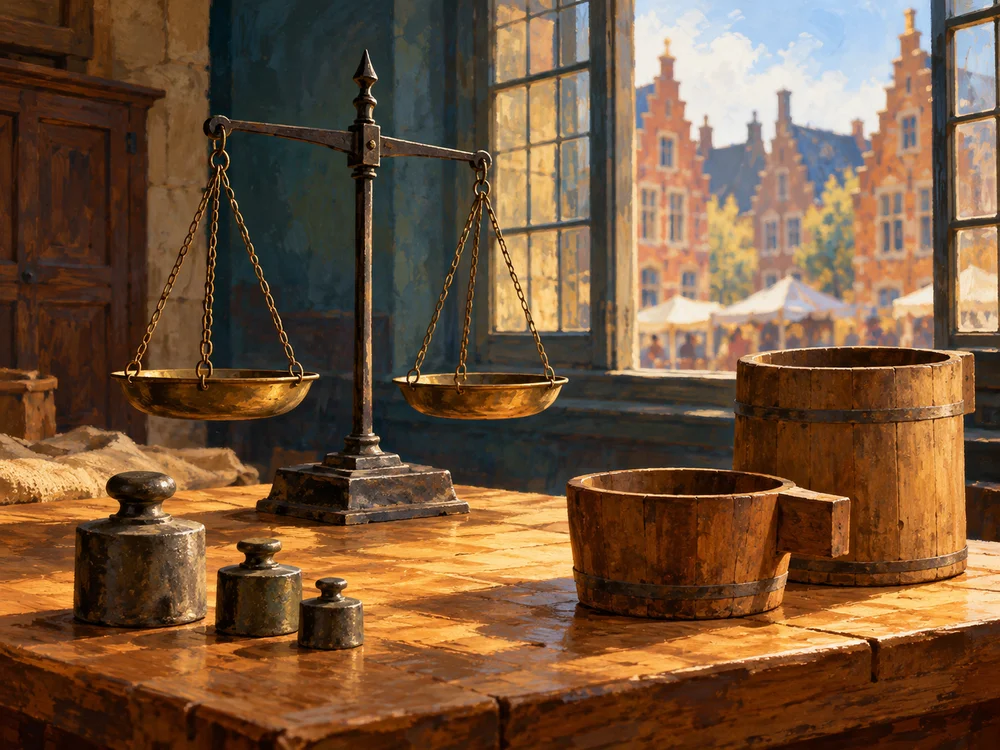
The building’s later uses also matter to how it is read today. The museum says its weighing function ended in the nineteenth century; a drawing school and briefly a telegraph station followed, and it became a museum in 1915. An interior seen today therefore needs dated evidence before it can be treated as an intact working weigh house. The generated illustration is an invented still life about measurement. Its balance and vessels are no record of the Waag’s equipment, layout or historical accuracy.
Brief place context adapted from Wikivoyage contributors · CC BY-SA 4.0; original explanation and exercise based on the museum history · Source credits · License and reuse terms