A CLOSER LOOK
Wikivoyage places Davenport on the Mississippi River in eastern Iowa, within the Quad Cities. This page follows one connection across that river: Government Bridge, linking Davenport with Rock Island Arsenal. Its history offers a specific question for a curious observer: which part of a crossing does a construction date describe?
The Army’s Government Bridge history dates the bridge to 1896 and its reused piers to 1872. It identifies Ralph Modjeski as the designer of the steel replacement and says the earlier iron bridge had become inadequate for heavier locomotives. Reusing the supports joined a new structure to an earlier building campaign. These dates describe a documented reuse decision; they do not date every physical component or subsequent repair.
The older rail crossing needs a separate place in the story. The Army’s First Bridge Pier account describes the 1856 wooden bridge with a swing span near mid-channel. Its successors eventually moved to the Government Bridge site, where the 1872 bridge was constructed. That sequence matters when reading the phrase first railroad bridge across the Mississippi. It identifies a historical crossing, without making the present steelwork an 1856 survival.
Try an original two-strip reading exercise. On one paper strip, write piers and the source-supported year 1872. On another, write steel bridge and 1896. Lay the strips together to represent the assembly. Now add an imagined later repair to only one strip, keeping its date explicitly fictional. Notice how a whole-bridge label loses information about the unchanged component. A useful caption names the part that its date actually describes.
There is also a question about movement. The Government Bridge account describes railway tracks on the upper deck, a roadway below and a swing span for river traffic. Sketch a fictional river crossing and trace a train’s journey across it. On a separate sheet, trace a boat’s journey along the channel. Ask which part of your imagined crossing would need to move to make each route possible. Keep the sketch schematic: the exercise explains the coexistence of crossing and navigation, and supplies no dimensions or operating procedure for this bridge.
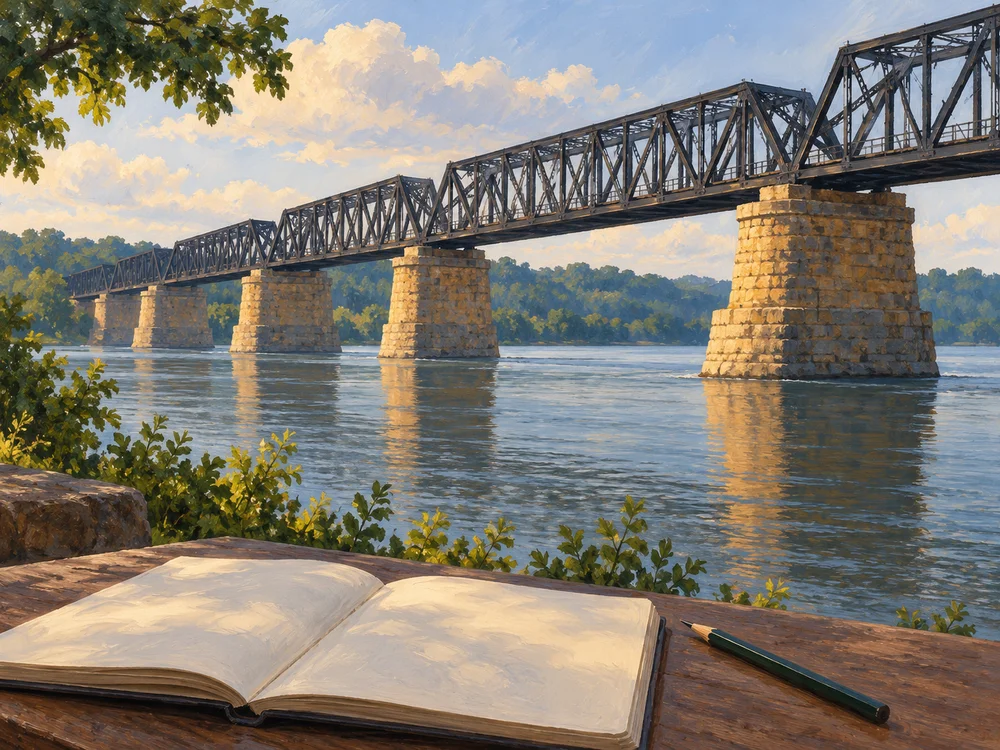
Use an identified photograph to ask what further evidence would connect visible material to a building campaign. A dated repair record might answer a question that appearance leaves open. The Army articles are historical accounts published in 2019; this page makes no present structural-condition assessment or promise of visitor access. The generated bridge scene invents its geometry and setting. It illustrates layered construction history and cannot identify an actual pier or document an engineering detail.
Adapted place context: Wikivoyage contributors · CC BY-SA 4.0; bridge histories credited below · Source credits · License and reuse terms