A CLOSER LOOK
Oxford physicist Robert Walker purchased the apparatus for the university’s collection. A label in his handwriting says “Set up in 1840,” while a later note suggests it may have been made about fifteen years earlier. The instrument remains in a display case near the entrance of the Clarendon Laboratory, where the movement can be seen while its ringing is muffled.
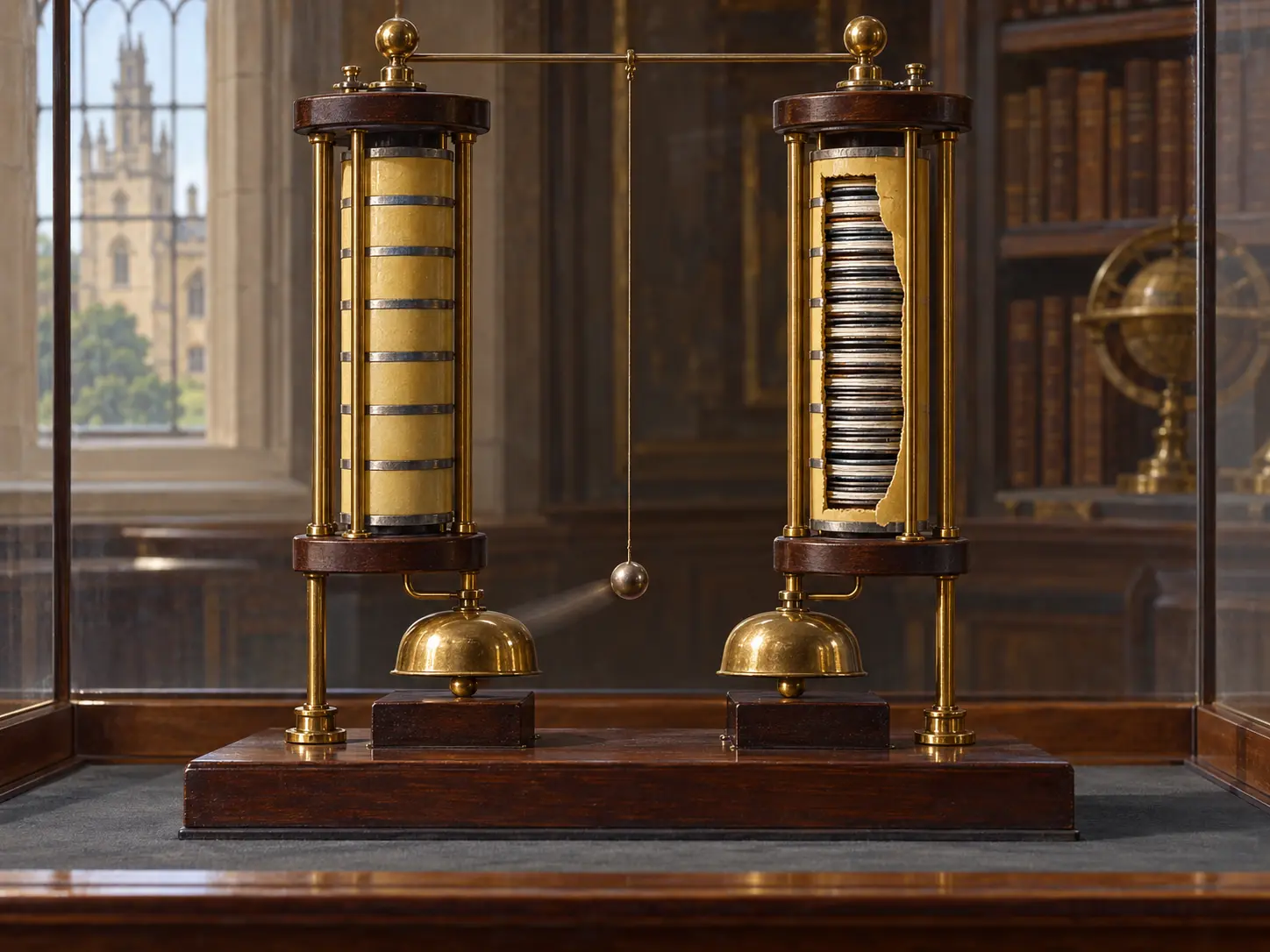
Two tall voltaic dry piles are connected in series, with a small brass bell at the lower end of each. A metal sphere about four millimetres across hangs between them. Electrostatic attraction pulls the sphere to one bell. Contact transfers charge, reversing the force and sending it toward the other bell. The repeated exchange produces about two oscillations each second.
Oxford estimates that the bells have been struck on the order of ten billion times. That figure comes from the long operating interval and approximate oscillation rate rather than a counter recording every impact. The apparatus has endured because each stroke requires exceptionally little current, even though the piles maintain enough voltage to move the light clapper.
The sealed piles have not been dismantled, so their exact internal construction remains uncertain. Oxford’s archive compares them with period Zamboni piles and suggests alternating layers of metal foil and paper coated with manganese dioxide. That is a historically informed reconstruction rather than a direct inventory of the material hidden inside these columns.
Dry piles descend from early voltaic batteries assembled from many thin layers. A 1915 account in Nature described the Oxford apparatus after roughly seventy-five years of activity and traced similar piles to paper discs coated with metals. Thousands of small electrochemical junctions could create high voltage while supplying only a minute current.
The device is sometimes described as perpetual motion, a label Oxford rejects. Its motion draws finite energy from chemical processes in the piles, and mechanical parts also wear. The experiment will eventually stop when the available potential can no longer move the sphere or when a component fails. Its remarkable duration shows how long a battery can work when the energy demanded at any moment is tiny.