A CLOSER LOOK
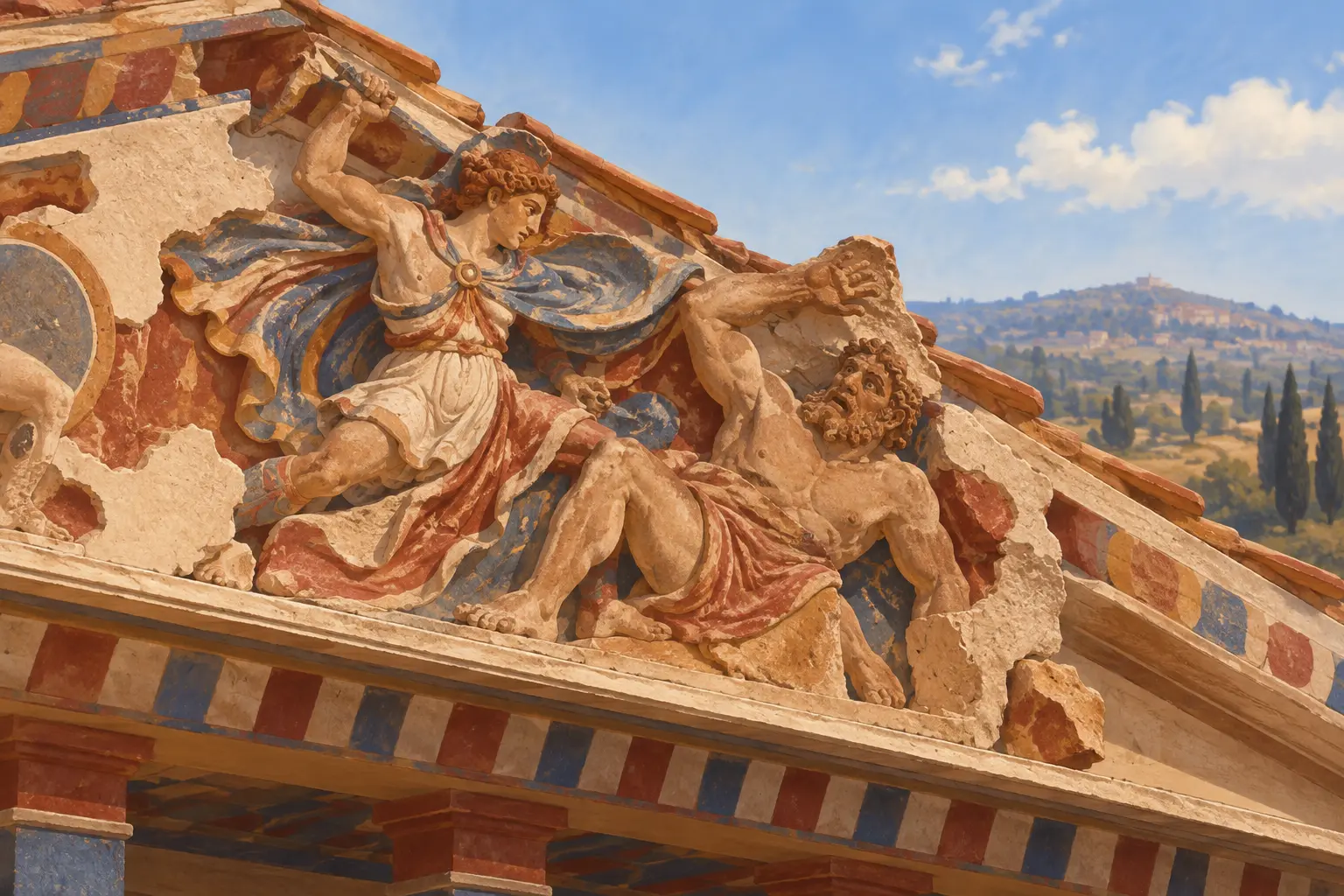
The Art Institute of Chicago identifies this object as an Etruscan architectural relief made from terracotta with pigment in the third or second century BCE. A flowing-robed god confronts a Giant in a surviving section of the Gigantomachy, the mythic war between the Olympian gods and their earthborn opponents. The broken edges matter: this was one portion of a larger decorative scheme, and the complete sequence cannot be recovered from the fragment alone.
Fired clay made large architectural ornament possible without carving every element from stone. The surviving pigment also warns against imagining ancient rooflines as bare monochrome surfaces. Etruscan makers used modeled terracotta and color to make figures readable at architectural scale; weather, reuse, and burial have removed much of the original finish. The object can show the material and visual ambition of that practice, though it does not identify its building or patron.
The broader Greek story made the Gigantomachy a struggle over the order of the cosmos. Brown University’s Joukowsky Institute notes that the gods required the mortal Heracles to win and that ancient viewers could connect the defeated Giants with chaos or threatening outsiders. Those associations help explain the theme’s force, but they are context rather than a decoded message: this Etruscan fragment does not preserve enough evidence to prove a local political meaning.
The generated illustration places an interpretive relief on an Etruscan-style roofline so its architectural role is easy to see. It draws on the cited material, date, pigment, and subject. It is new editorial artwork, not a reconstruction of the missing composition, an authentic photograph, or archaeological evidence.