A CLOSER LOOK
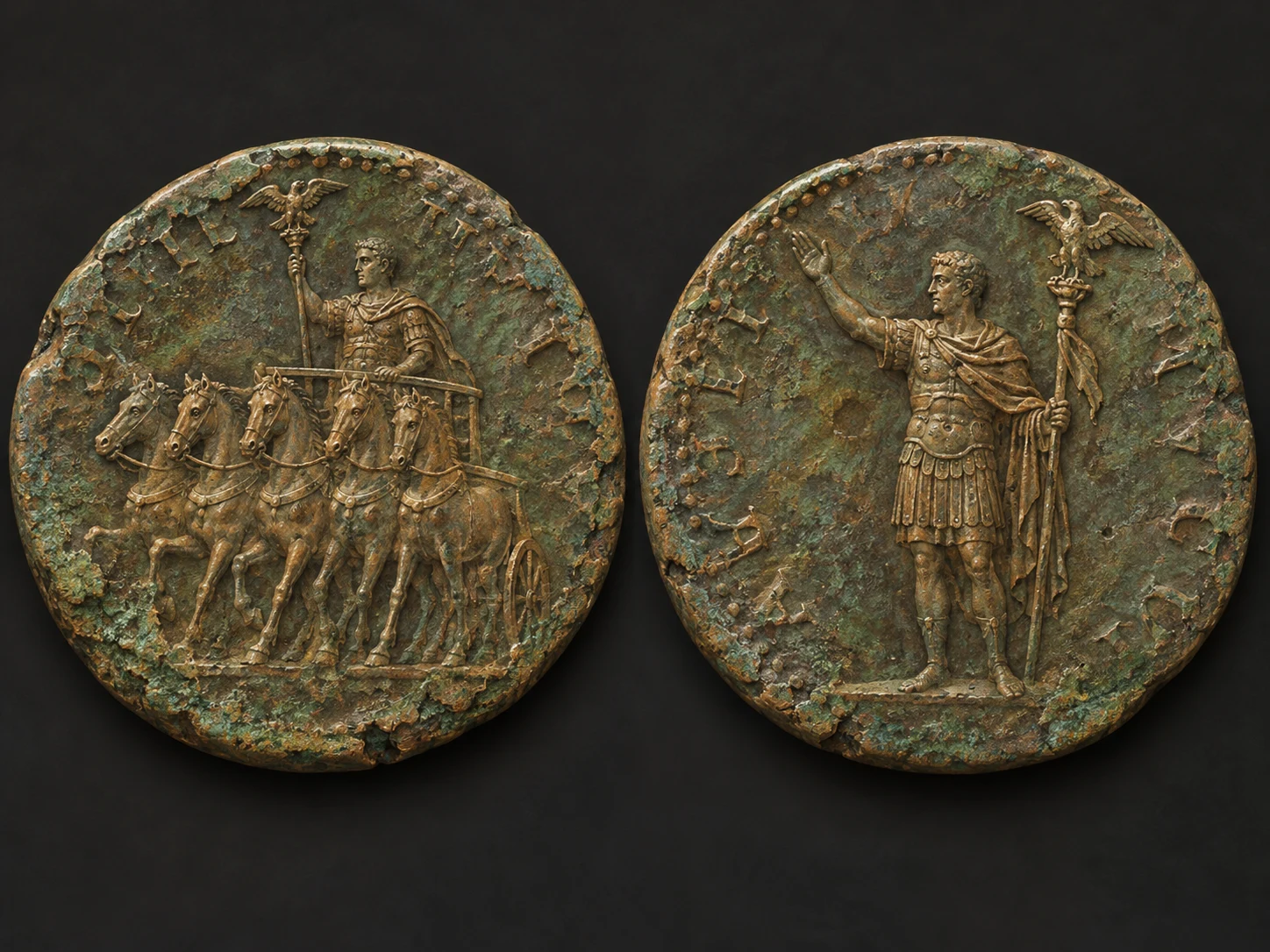
The Art Institute identifies this object as a Roman bronze dupondius portraying Germanicus. Comparison with matching museum records dates the type to 37–41 CE, the reign of his son Gaius, commonly called Caligula. Germanicus had died in 19 CE. The image is therefore posthumous commemoration, and the site’s earlier life-date label of 15 BCE–19 CE described the man rather than the coin’s minting.
One face shows Germanicus standing in a quadriga, a chariot drawn by four horses, and holding an eagle-tipped sceptre. The other shows him in military dress with one hand raised and a legionary eagle in the other. The British Museum and London Museum describe the same type and its legend, “SIGNIS RECEPT DEVICTIS GERM,” which announces recovered standards and defeated Germans.
Those standards carried the identity and honor of Roman legions. Several were lost when Roman forces were destroyed in the Teutoburg Forest in 9 CE; Germanicus recovered two during later campaigns. The quadriga recalls the triumph awarded to him in 17 CE. By pairing the procession with the eagle, the coin makes recovery itself the center of the victory story.
The issue also belonged to Caligula’s present. A ruler whose authority rested partly on descent could place his admired father on everyday money and make a family claim visible across the empire. That political reading is supported by the choice and timing of the type, though a worn coin cannot tell us how any individual user understood it. The generated illustration enlarges the documented motifs for study; it is not the Art Institute object, a facsimile, or evidence about its exact surface.