YOUR NEXT DISCOVERY/SpaceFollow your curiosity
NASA's Spitzer Spots a Perfectly Sideways Galaxy
NASA / JPL · Reuse terms

Space / 2019-07-31

NASA's Spitzer Spots a Perfectly Sideways Galaxy

NASA's Spitzer Spots a Perfectly Sideways Galaxy

NASA's image library records NASA's Spitzer Spots a Perfectly Sideways Galaxy.

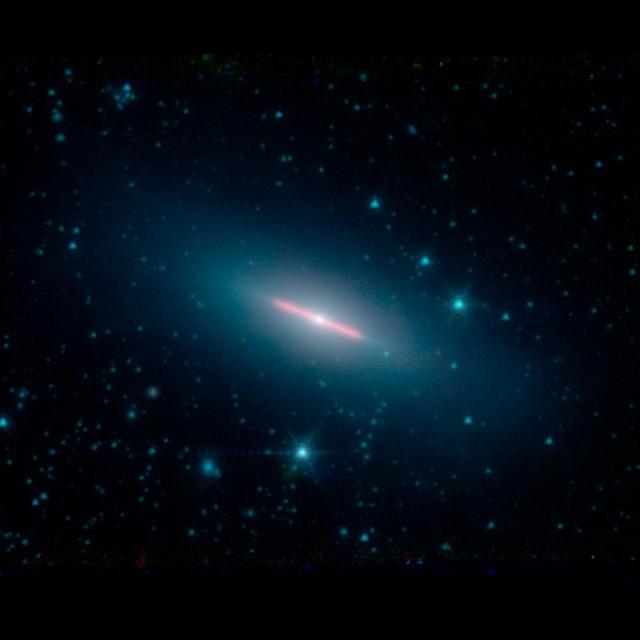
Galaxy NGC 5866 lies 44 million light-years from Earth and has a diameter of roughly 60,000 light-years — a little more than half the diameter of our own Milky Way galaxy. From our viewpoint, NGC 5866 is oriented almost exactly edge-on, yielding most of its structural features invisible. Spitzer detects infrared light, and the red color here corres

SERENDIPITYA little unexpected
FamiliarWeird

Galaxy NGC 5866 lies 44 million light-years from Earth and has a diameter of roughly 60,000 light-years — a little more than half the diameter of our own Milky Way galaxy. From our viewpoint, NGC 5866 is oriented almost exactly edge-on, yielding most of its structural features invisible. Spitzer detects infrared light, and the red color here corresponds to a wavelength typically emitted by dust. The clean edges of the dust emission from NGC 5866 indicate that there is a very flat ring or disk of dust circling the outer region of the galaxy. Spitzer took this image during its "cold" mission, which ended in 2009. The colors represent three infrared wavelengths captured by the Infrared Array Camera instrument. Blue light corresponds to a wavelength of 3.6 microns, produced mainly by stars; gr

Explore NASA's original image record for credits and available downloads.

NASA Image and Video LibraryNASA's Spitzer Spots a Perfectly Sideways Galaxy

Original explanation based on the sources above. Images carry their own reuse terms.