YOUR NEXT DISCOVERY/SpaceFollow your curiosity
Cepheus C and Cepheus B Region by Spitzer (One-Instrument)
NASA / JPL · Reuse terms

Space / 2019-05-30

Cepheus C and Cepheus B Region by Spitzer (One-Instrument)

Cepheus C and Cepheus B Region by Spitzer (One-Instrument)

NASA's image library records Cepheus C and Cepheus B Region by Spitzer (One-Instrument).

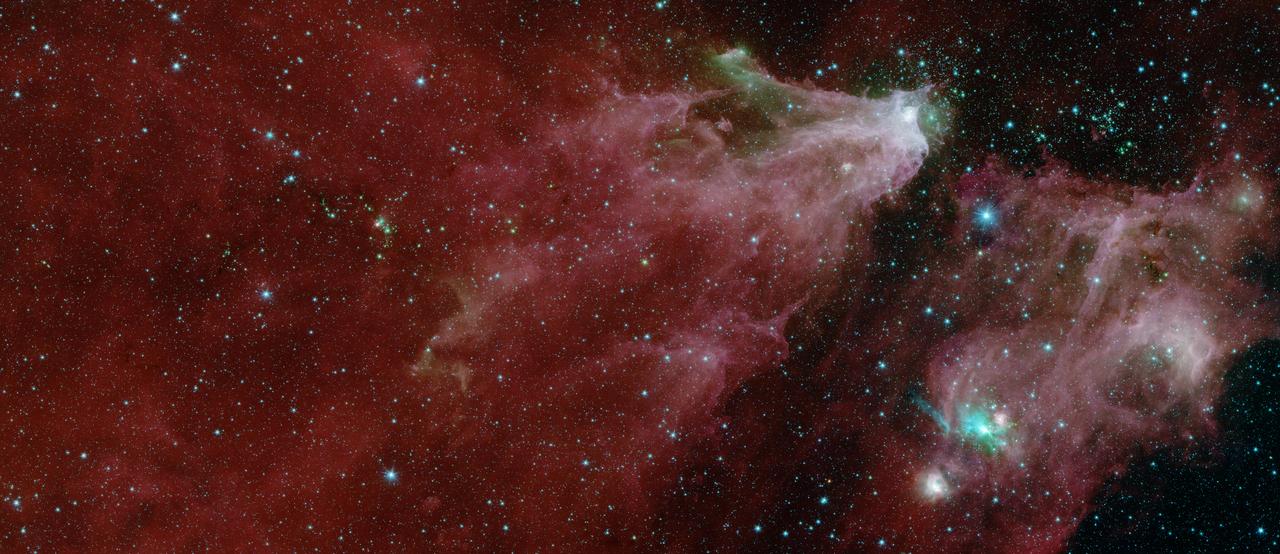
This image shows data from NASA's Spitzer Space Telescope, from the IRAC instrument, with colors corresponding to wavelengths of 3.6, 4.5, 5.8 and 8.0 µm (shown as blue, green, orange and red). The grand red delta filling most of the image is a far-away nebula, or a cloud of gas and dust. A second nebula is located in the lower right portion of the

SERENDIPITYA little unexpected
FamiliarWeird

This image shows data from NASA's Spitzer Space Telescope, from the IRAC instrument, with colors corresponding to wavelengths of 3.6, 4.5, 5.8 and 8.0 µm (shown as blue, green, orange and red). The grand red delta filling most of the image is a far-away nebula, or a cloud of gas and dust. A second nebula is located in the lower right portion of the image. Within the first nebula, on the left side of this image, a dark filament runs horizontally through the green cloud. A smattering of baby stars (the red and yellow dots) appear inside it. Known as Cepheus C, the area is a particularly dense concentration of gas and dust where infant stars form. This region is called Cepheus C because it lies in the constellation Cepheus, which can be found near the constellation Cassiopeia. Cepheus-C is ab

Explore NASA's original image record for credits and available downloads.

NASA Image and Video LibraryCepheus C and Cepheus B Region by Spitzer (One-Instrument)

Original explanation based on the sources above. Images carry their own reuse terms.