YOUR NEXT DISCOVERY/SpaceFollow your curiosity
NASA's Hubble Spots Embryonic Galaxy SPT0615-JD
NASA / JPL · Reuse terms

Space / 2018-01-11

NASA's Hubble Spots Embryonic Galaxy SPT0615-JD

NASA's Hubble Spots Embryonic Galaxy SPT0615-JD

NASA's image library records NASA's Hubble Spots Embryonic Galaxy SPT0615-JD.

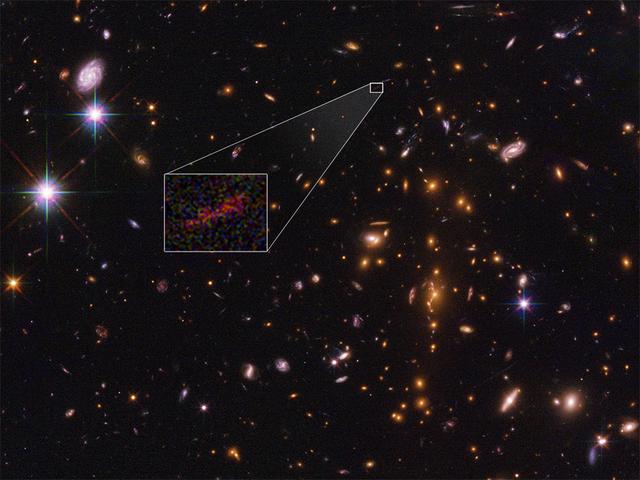
This Hubble Space Telescope image shows the farthest galaxy yet seen in an image that has been stretched and amplified by a phenomenon called gravitational lensing. The embryonic galaxy, named SPT0615-JD, existed when the universe was just 500 million years old. Though a few other primitive galaxies have been seen at this early epoch, they have ess

SERENDIPITYA little unexpected
FamiliarWeird

This Hubble Space Telescope image shows the farthest galaxy yet seen in an image that has been stretched and amplified by a phenomenon called gravitational lensing. The embryonic galaxy, named SPT0615-JD, existed when the universe was just 500 million years old. Though a few other primitive galaxies have been seen at this early epoch, they have essentially all looked like red dots, given their small size and tremendous distances. However, in this case, the gravitational field of a massive foreground galaxy cluster, called SPT-CL J0615-5746, not only amplified the light from the background galaxy but also smeared the image of it into an arc (about 2 arcseconds long). Image analysis shows that the galaxy weighs in at no more than 3 billion solar masses (roughly 1/100th the mass of our fully

Explore NASA's original image record for credits and available downloads.

NASA Image and Video LibraryNASA's Hubble Spots Embryonic Galaxy SPT0615-JD

Original explanation based on the sources above. Images carry their own reuse terms.