YOUR NEXT DISCOVERY/SpaceFollow your curiosity
Odds of a Cosmic Bullseye
NASA / JPL · Reuse terms

Space / 2017-06-02

Odds of a Cosmic Bullseye

Odds of a Cosmic Bullseye

NASA's image library records Odds of a Cosmic Bullseye.

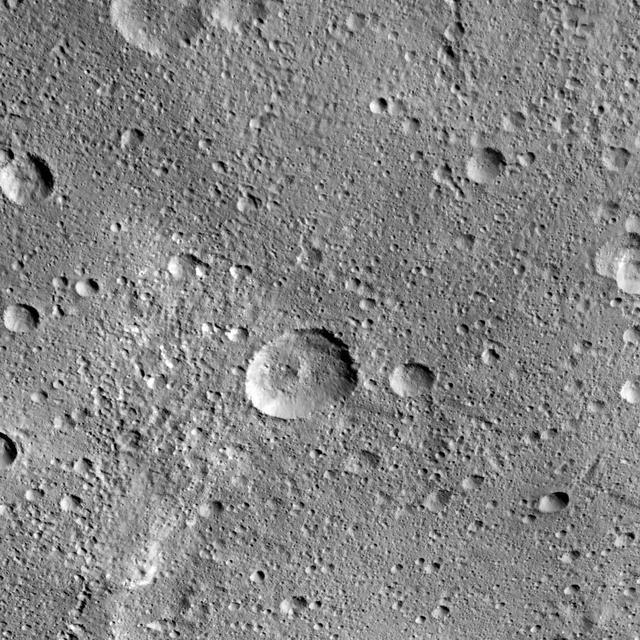
The 16-mile-wide (26-kilometer-wide) crater Insitor is located almost exactly in the center of Kerwan crater on Ceres. Scientists can compute the chances that a cosmic dart would hit exactly at the bullseye of the largest crater on Ceres by using models of impact frequency as a function of time, combined with the period of time since Kerwan's forma

SERENDIPITYA little unexpected
FamiliarWeird

The 16-mile-wide (26-kilometer-wide) crater Insitor is located almost exactly in the center of Kerwan crater on Ceres. Scientists can compute the chances that a cosmic dart would hit exactly at the bullseye of the largest crater on Ceres by using models of impact frequency as a function of time, combined with the period of time since Kerwan's formation. By counting the number of craters within Kerwan and comparing that number to the distribution of craters on Earth's moon and other bodies, it is possible to derive an approximate time for Kerwan's formation of between 550 and 750 million years ago. The chance that a crater the size of Insitor would be formed at the center of Kerwan over that period is only one in one hundred. This image of Ceres was obtained by NASA's Dawn spacecraft on Sep

Explore NASA's original image record for credits and available downloads.

NASA Image and Video LibraryOdds of a Cosmic Bullseye

Original explanation based on the sources above. Images carry their own reuse terms.