YOUR NEXT DISCOVERY/SpaceFollow your curiosity
Regarding Rhea
NASA / JPL · Reuse terms

Space / 2016-08-01

Regarding Rhea

Regarding Rhea

NASA's image library records Regarding Rhea.

Rhea, like many moons in the outer solar system, appears dazzlingly bright in full sunlight. This is the signature of the water ice that forms most of the moon's surface. Rhea (949 miles or 1,527 kilometers across) is Saturn's second largest moon after Titan. Its ancient surface is one of the most heavily cratered of all of Saturn's moons. Subtle a

SERENDIPITYA little unexpected
FamiliarWeird

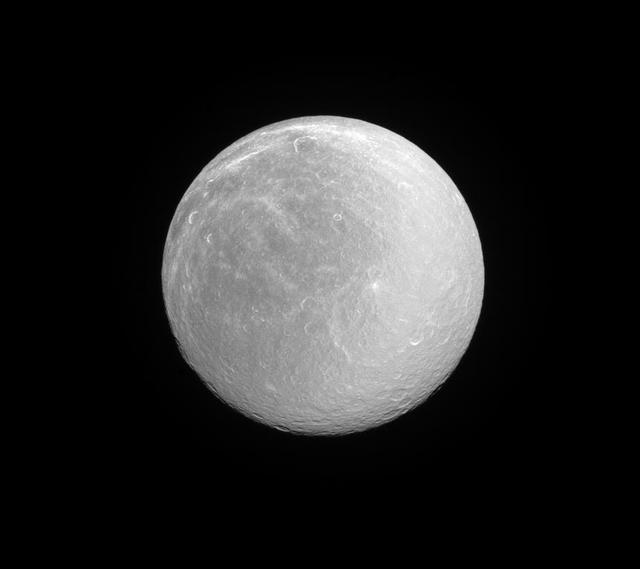
Rhea, like many moons in the outer solar system, appears dazzlingly bright in full sunlight. This is the signature of the water ice that forms most of the moon's surface. Rhea (949 miles or 1,527 kilometers across) is Saturn's second largest moon after Titan. Its ancient surface is one of the most heavily cratered of all of Saturn's moons. Subtle albedo variations across the disk of Rhea hint at past geologic activity. This view looks toward the anti-Saturn hemisphere of Rhea. North on Rhea is up and rotated 36 degrees to the right. The image was taken with the Cassini spacecraft narrow-angle camera on June 3, 2016 using a spectral filter which preferentially admits wavelengths of ultraviolet light centered at 338 nanometers. http://photojournal.jpl.nasa.gov/catalog/PIA20495

Explore NASA's original image record for credits and available downloads.

NASA Image and Video LibraryRegarding Rhea

Original explanation based on the sources above. Images carry their own reuse terms.