YOUR NEXT DISCOVERY/SpaceFollow your curiosity
Faint Compact Galaxy in the Early Universe
NASA / JPL · Reuse terms

Space / 2015-12-03

Faint Compact Galaxy in the Early Universe

Faint Compact Galaxy in the Early Universe

NASA's image library records Faint Compact Galaxy in the Early Universe.

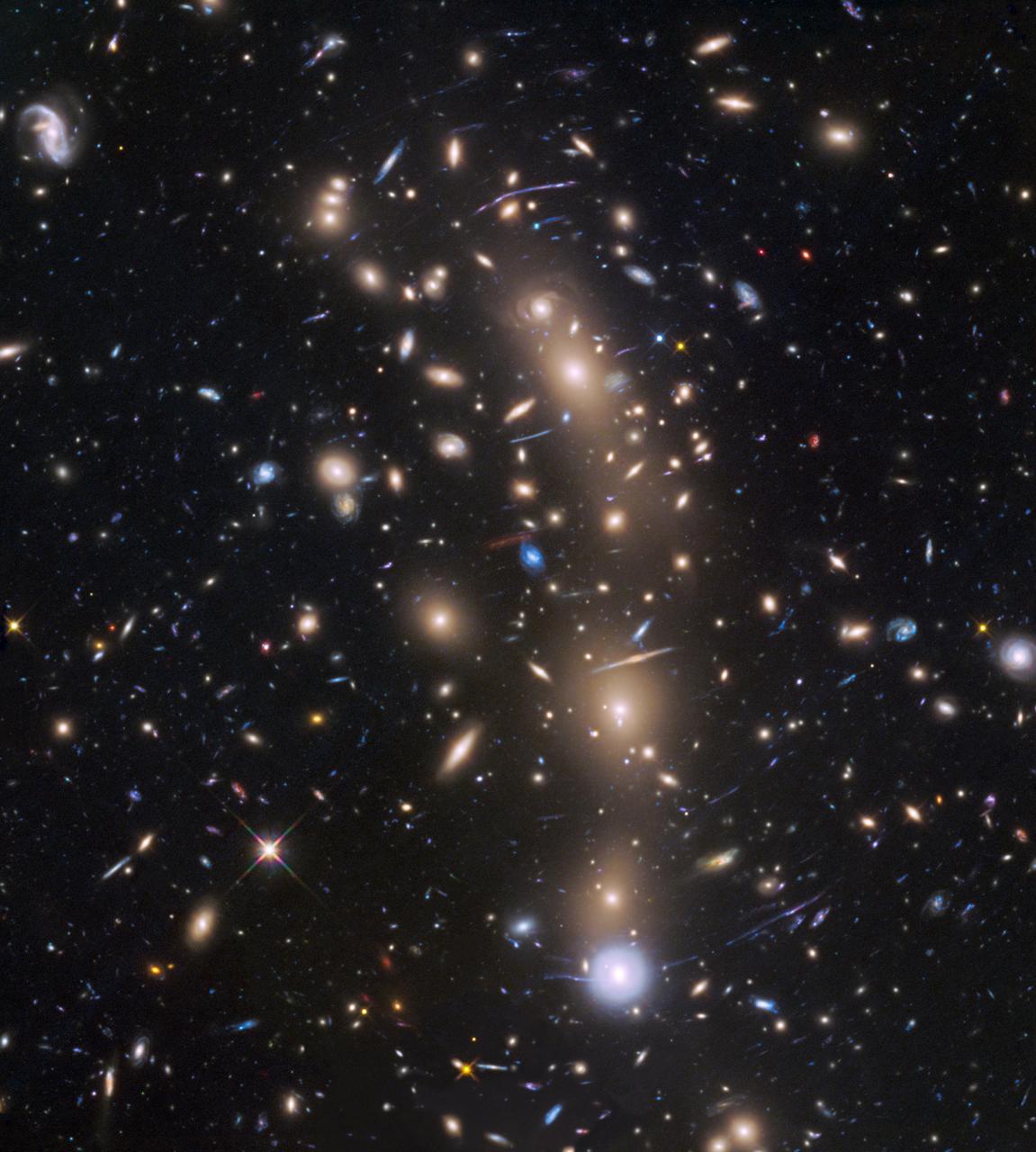
This is a Hubble Space Telescope view of a very massive cluster of galaxies, MACS J0416.1-2403, located roughly 4 billion light-years away and weighing as much as a million billion suns. The cluster's immense gravitational field magnifies the image of galaxies far behind it, in a phenomenon called gravitational lensing. The inset is an image of an

SERENDIPITYA little unexpected
FamiliarWeird

This is a Hubble Space Telescope view of a very massive cluster of galaxies, MACS J0416.1-2403, located roughly 4 billion light-years away and weighing as much as a million billion suns. The cluster's immense gravitational field magnifies the image of galaxies far behind it, in a phenomenon called gravitational lensing. The inset is an image of an extremely faint and distant galaxy that existed only 400 million years after the big bang. It was discovered by Hubble and NASA's Spitzer Space Telescope. The gravitational lens makes the galaxy appear 20 times brighter than normal. The galaxy is comparable in size to the Large Magellanic Cloud (LMC), a diminutive satellite galaxy of our Milky Way. It is rapidly making stars at a rate ten times faster than the LMC. This might be the growing core

Explore NASA's original image record for credits and available downloads.

NASA Image and Video LibraryFaint Compact Galaxy in the Early Universe

Original explanation based on the sources above. Images carry their own reuse terms.