YOUR NEXT DISCOVERY/SpaceFollow your curiosity
Cosmic Blasting Zone
NASA / JPL · Reuse terms

Space / 2005-12-06

Cosmic Blasting Zone

Cosmic Blasting Zone

NASA's image library records Cosmic Blasting Zone.

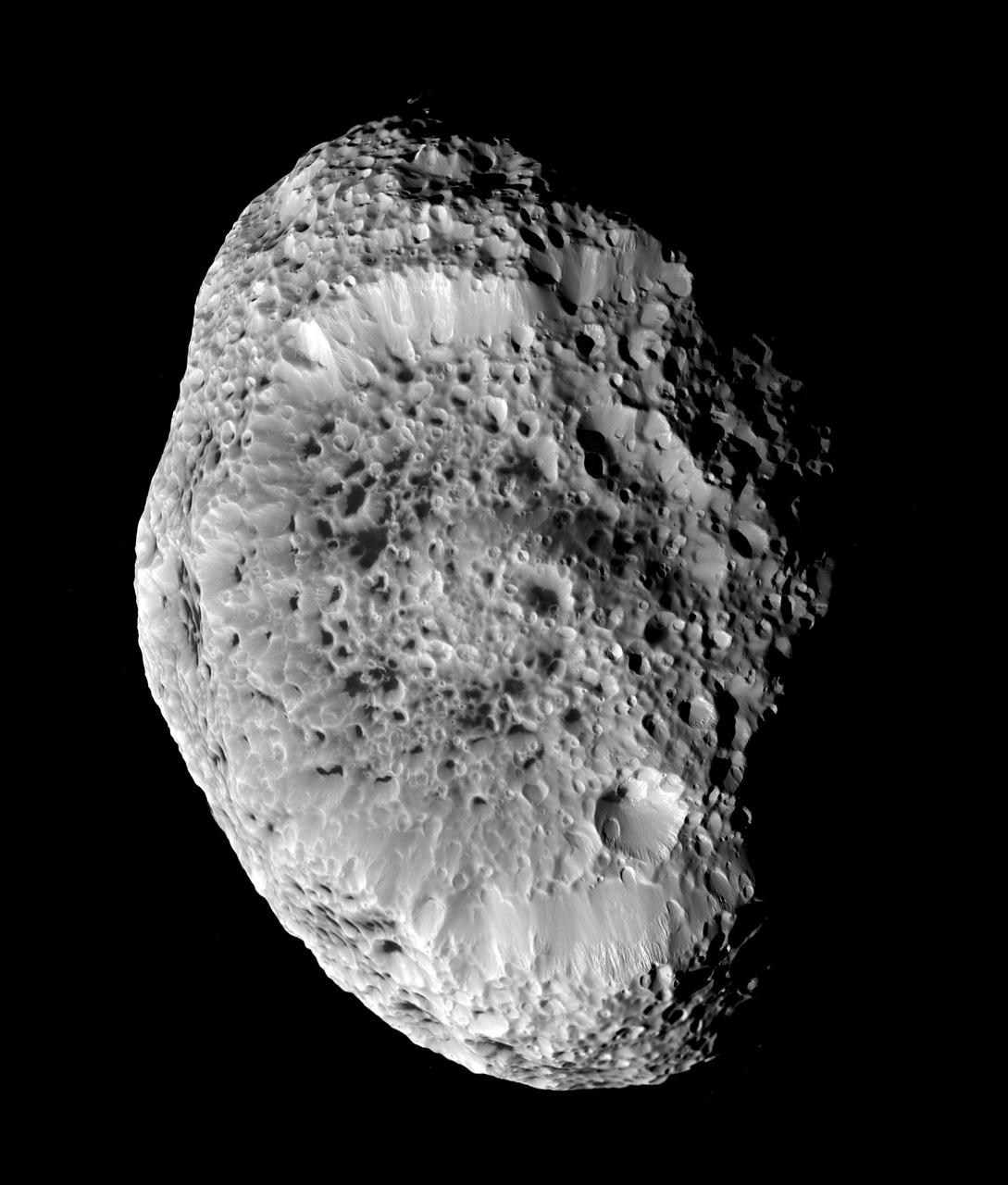
Saturn's impact-pummeled Hyperion stares back at Cassini in this six-image mosaic taken during the spacecraft’s close approach on Sept. 26, 2005. This up-close view shows a low density body blasted by impacts over the eons. Scientists originally believed that the spongy appearance of Hyperion is caused by a phenomenon called thermal erosion, in whi

SERENDIPITYA little unexpected
FamiliarWeird

Saturn's impact-pummeled Hyperion stares back at Cassini in this six-image mosaic taken during the spacecraft’s close approach on Sept. 26, 2005. This up-close view shows a low density body blasted by impacts over the eons. Scientists originally believed that the spongy appearance of Hyperion is caused by a phenomenon called thermal erosion, in which dark materials accumulating on crater floors are warmed by sunlight and melt deeper into the surface, allowing surrounding ice to vaporize away. Cassini scientists now think that Hyperion’s unusual appearance can be attributed to the fact that it has an unusually low density for such a large object, giving it weak surface gravity and high porosity. These characteristics help preserve the original shapes of Hyperion’s craters by limiting the am

Explore NASA's original image record for credits and available downloads.

NASA Image and Video LibraryCosmic Blasting Zone

Original explanation based on the sources above. Images carry their own reuse terms.