YOUR NEXT DISCOVERY/SpaceFollow your curiosity
Life at the Intersection of Colliding Galaxies
NASA / JPL · Reuse terms

Space / 2004-09-07

Life at the Intersection of Colliding Galaxies

Life at the Intersection of Colliding Galaxies

NASA's image library records Life at the Intersection of Colliding Galaxies.

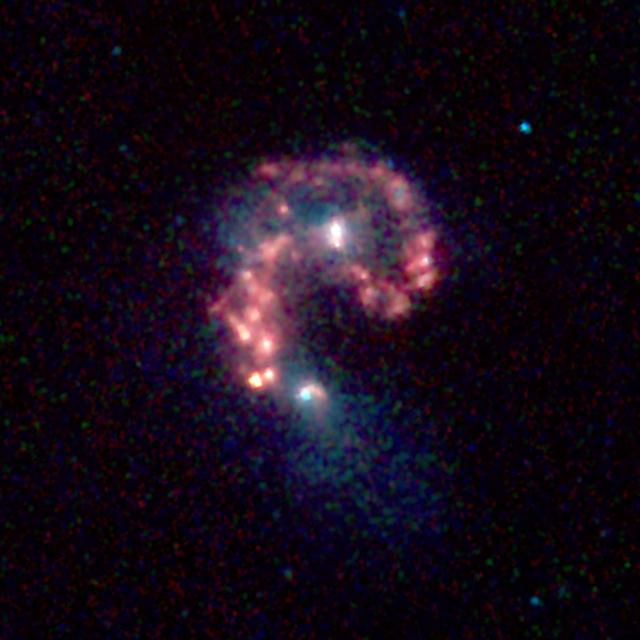
This false-color image from NASA's Spitzer Space Telescope reveals hidden populations of newborn stars at the heart of the colliding "Antennae" galaxies. These two galaxies, known individually as NGC 4038 and 4039, are located around 68 million light-years away and have been merging together for about the last 800 million years. The latest Spitzer

SERENDIPITYA little unexpected
FamiliarWeird

This false-color image from NASA's Spitzer Space Telescope reveals hidden populations of newborn stars at the heart of the colliding "Antennae" galaxies. These two galaxies, known individually as NGC 4038 and 4039, are located around 68 million light-years away and have been merging together for about the last 800 million years. The latest Spitzer observations provide a snapshot of the tremendous burst of star formation triggered in the process of this collision, particularly at the site where the two galaxies overlap. The image was taken by Spitzer's infrared array camera and is a combination of infrared light ranging from 3.6 microns (shown in blue) to 8.0 microns (shown in red). The dust emission (red) is by far the strongest feature in this image. Starlight was systematically subtracte

Explore NASA's original image record for credits and available downloads.

NASA Image and Video LibraryLife at the Intersection of Colliding Galaxies

Original explanation based on the sources above. Images carry their own reuse terms.