YOUR NEXT DISCOVERY/SpaceFollow your curiosity
GeV-gamma-ray emission regions
NASA / GSFC · Reuse terms

Space / 2017-12-08

GeV-gamma-ray emission regions

GeV-gamma-ray emission regions

NASA's image library records GeV-gamma-ray emission regions.

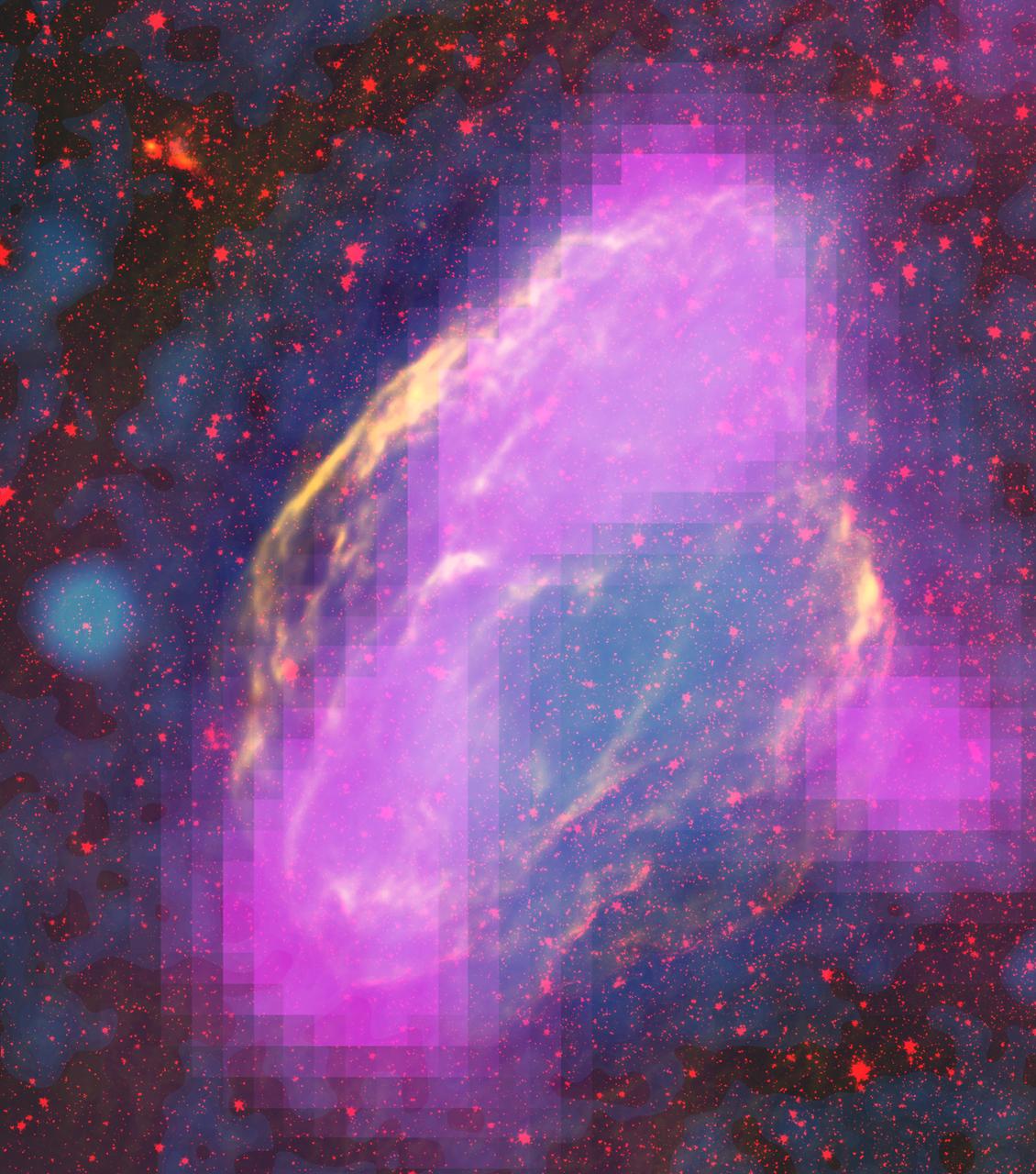
NASA's Fermi Closes on Source of Cosmic Rays New images from NASA's Fermi Gamma-ray Space Telescope show where supernova remnants emit radiation a billion times more energetic than visible light. The images bring astronomers a step closer to understanding the source of some of the universe's most energetic particles -- cosmic rays. Fermi mapped GeV

SERENDIPITYA little unexpected
FamiliarWeird

NASA's Fermi Closes on Source of Cosmic Rays New images from NASA's Fermi Gamma-ray Space Telescope show where supernova remnants emit radiation a billion times more energetic than visible light. The images bring astronomers a step closer to understanding the source of some of the universe's most energetic particles -- cosmic rays. Fermi mapped GeV-gamma-ray emission regions (magenta) in the W44 supernova remnant. The features clearly align with filaments detectable in other wavelengths. This composite merges X-rays (blue) from the Germany-led ROSAT mission, infrared (red) from NASA's Spitzer Space Telescope, and radio (orange) from the Very Large Array near Socorro, N.M. Credit: NASA/DOE/Fermi LAT Collaboration, ROSAT, JPL-Caltech, and NRAO/AUI For more information: www.nasa.gov/mission_p

Explore NASA's original image record for credits and available downloads.

NASA Image and Video LibraryGeV-gamma-ray emission regions

Original explanation based on the sources above. Images carry their own reuse terms.