YOUR NEXT DISCOVERY/SpaceFollow your curiosity
Hubble Feathers the Peacock
NASA / GSFC · Reuse terms

Space / 2017-12-08

Hubble Feathers the Peacock

Hubble Feathers the Peacock

NASA's image library records Hubble Feathers the Peacock.

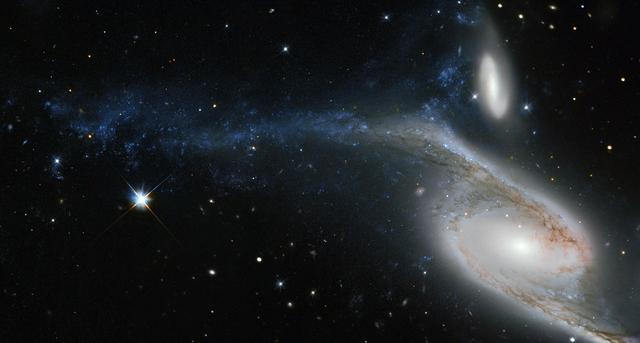
This picture, taken by the NASA/ESA Hubble Space Telescope’s Wide Field Planetary Camera 2 (WFPC2), shows a galaxy known as NGC 6872 in the constellation of Pavo (The Peacock). Its unusual shape is caused by its interactions with the smaller galaxy that can be seen just above NGC 6872, called IC 4970. They both lie roughly 300 million light-years a

SERENDIPITYA little unexpected
FamiliarWeird

This picture, taken by the NASA/ESA Hubble Space Telescope’s Wide Field Planetary Camera 2 (WFPC2), shows a galaxy known as NGC 6872 in the constellation of Pavo (The Peacock). Its unusual shape is caused by its interactions with the smaller galaxy that can be seen just above NGC 6872, called IC 4970. They both lie roughly 300 million light-years away from Earth. From tip to tip, NGC 6872 measures over 500,000 light-years across, making it the second largest spiral galaxy discovered to date. In terms of size it is beaten only by NGC 262, a galaxy that measures a mind-boggling 1.3 million light-years in diameter! To put that into perspective, our own galaxy, the Milky Way, measures between 100,000 and 120,000 light-years across, making NGC 6872 about five times its size. The upper left spir

Explore NASA's original image record for credits and available downloads.

NASA Image and Video LibraryHubble Feathers the Peacock

Original explanation based on the sources above. Images carry their own reuse terms.