YOUR NEXT DISCOVERY/SpaceFollow your curiosity
Hubble Sees an Ancient Globular Cluster
NASA / GSFC · Reuse terms

Space / 2017-12-08

Hubble Sees an Ancient Globular Cluster

Hubble Sees an Ancient Globular Cluster

NASA's image library records Hubble Sees an Ancient Globular Cluster.

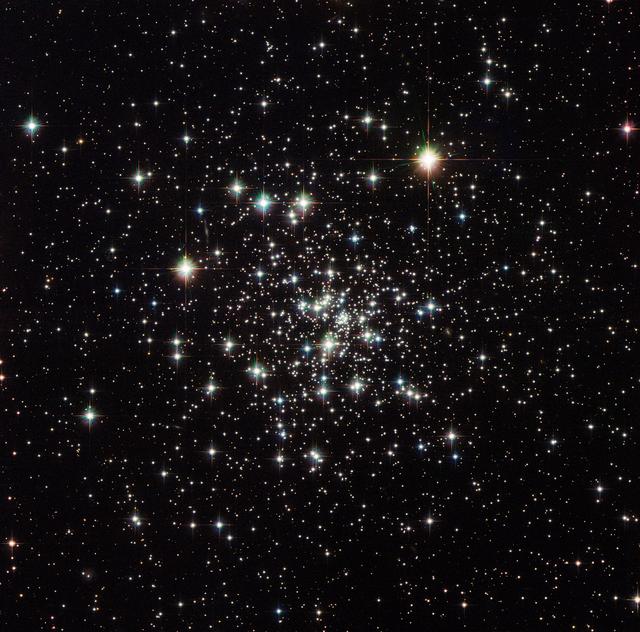
This image captures the stunning NGC 6535, a globular cluster 22,000 light-years away in the constellation of Serpens (The Serpent) that measures one light-year across. Globular clusters are tightly bound groups of stars which orbit galaxies. The large mass in the rich stellar centre of the globular cluster pulls the stars inward to form a ball of

SERENDIPITYA little unexpected
FamiliarWeird

This image captures the stunning NGC 6535, a globular cluster 22,000 light-years away in the constellation of Serpens (The Serpent) that measures one light-year across. Globular clusters are tightly bound groups of stars which orbit galaxies. The large mass in the rich stellar centre of the globular cluster pulls the stars inward to form a ball of stars. The word globulus, from which these clusters take their name, is Latin for small sphere. Globular clusters are generally very ancient objects formed around the same time as their host galaxy. To date, no new star formation has been observed within a globular cluster, which explains the abundance of aging yellow stars in this image, most of them containing very few heavy elements. NGC 6535 was first discovered in 1852 by English astronomer

Explore NASA's original image record for credits and available downloads.

NASA Image and Video LibraryHubble Sees an Ancient Globular Cluster

Original explanation based on the sources above. Images carry their own reuse terms.