YOUR NEXT DISCOVERY/SpaceFollow your curiosity
http://www.nasa.gov/image-feature/goddard/hubble-spots-the-layers-of-ngc-3923
NASA / GSFC · Reuse terms

Space / 2017-12-08

http://www.nasa.gov/image-feature/goddard/hubble-spots-the-layers-of-ngc-3923

http://www.nasa.gov/image-feature/goddard/hubble-spots-the-layers-of-ngc-3923

NASA's image library records http://www.nasa.gov/image-feature/goddard/hubble-spots-the-layers-of-ngc-3923.

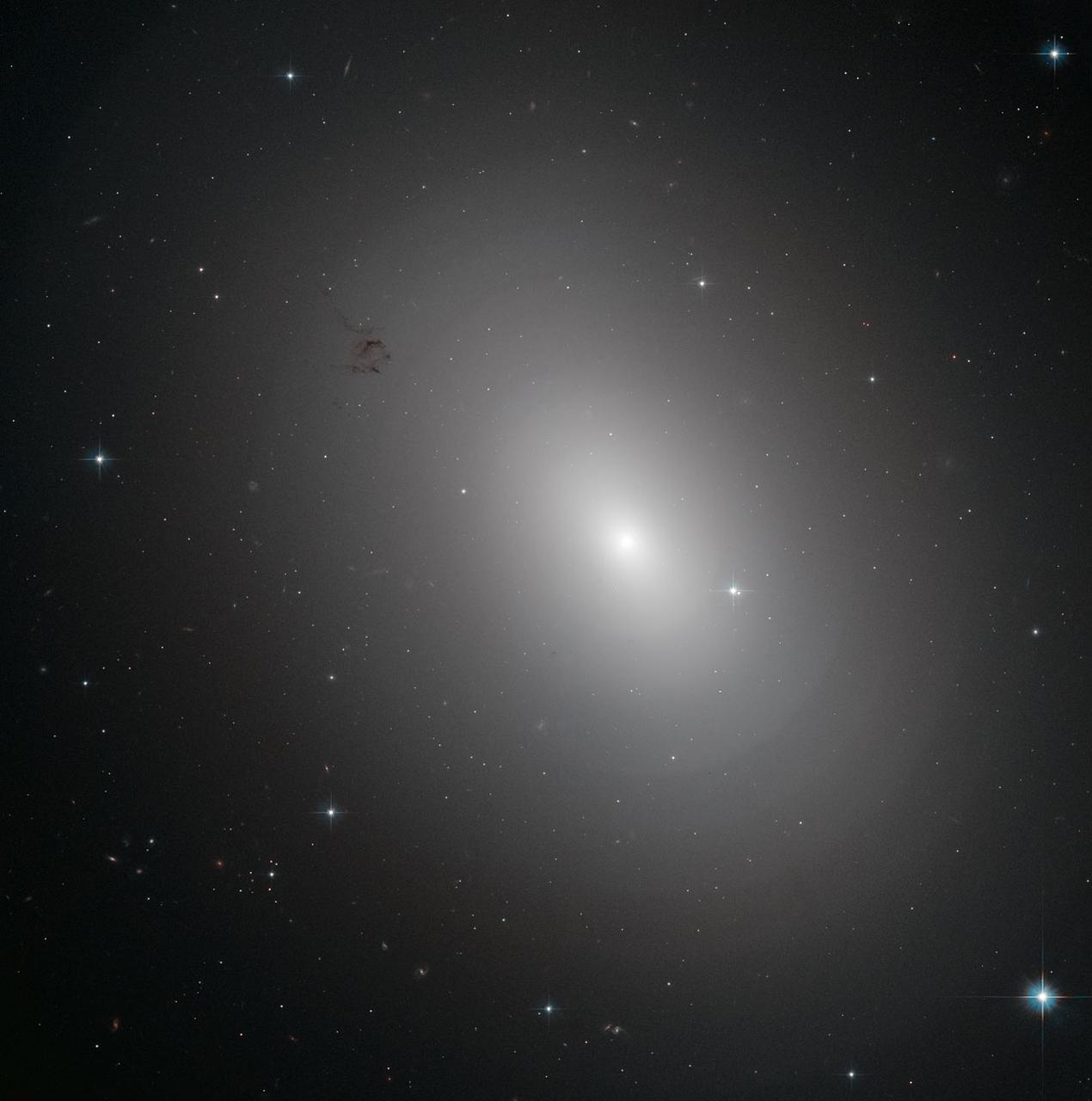
The glowing object in this Hubble Space Telescope image is an elliptical galaxy called NGC 3923. It is located over 90 million light-years away in the constellation of Hydra. NGC 3923 is an example of a shell galaxy where the stars in its halo are arranged in layers. Finding concentric shells of stars enclosing a galaxy is quite common and is obser

SERENDIPITYA little unexpected
FamiliarWeird

The glowing object in this Hubble Space Telescope image is an elliptical galaxy called NGC 3923. It is located over 90 million light-years away in the constellation of Hydra. NGC 3923 is an example of a shell galaxy where the stars in its halo are arranged in layers. Finding concentric shells of stars enclosing a galaxy is quite common and is observed in many elliptical galaxies. In fact, every tenth elliptical galaxy exhibits this onion-like structure, which has never been observed in spiral galaxies. The shell-like structures are thought to develop as a consequence of galactic cannibalism, when a larger galaxy ingests a smaller companion. As the two centers approach, they initially oscillate about a common center, and this oscillation ripples outwards forming the shells of stars just as

Explore NASA's original image record for credits and available downloads.

NASA Image and Video Libraryhttp://www.nasa.gov/image-feature/goddard/hubble-spots-the-layers-of-ngc-3923

Original explanation based on the sources above. Images carry their own reuse terms.