YOUR NEXT DISCOVERY/SpaceFollow your curiosity
Mars’ Moon Phobos is Slowly Falling Apart
NASA / GSFC · Reuse terms

Space / 2017-12-08

Mars’ Moon Phobos is Slowly Falling Apart

Mars’ Moon Phobos is Slowly Falling Apart

NASA's image library records Mars’ Moon Phobos is Slowly Falling Apart.

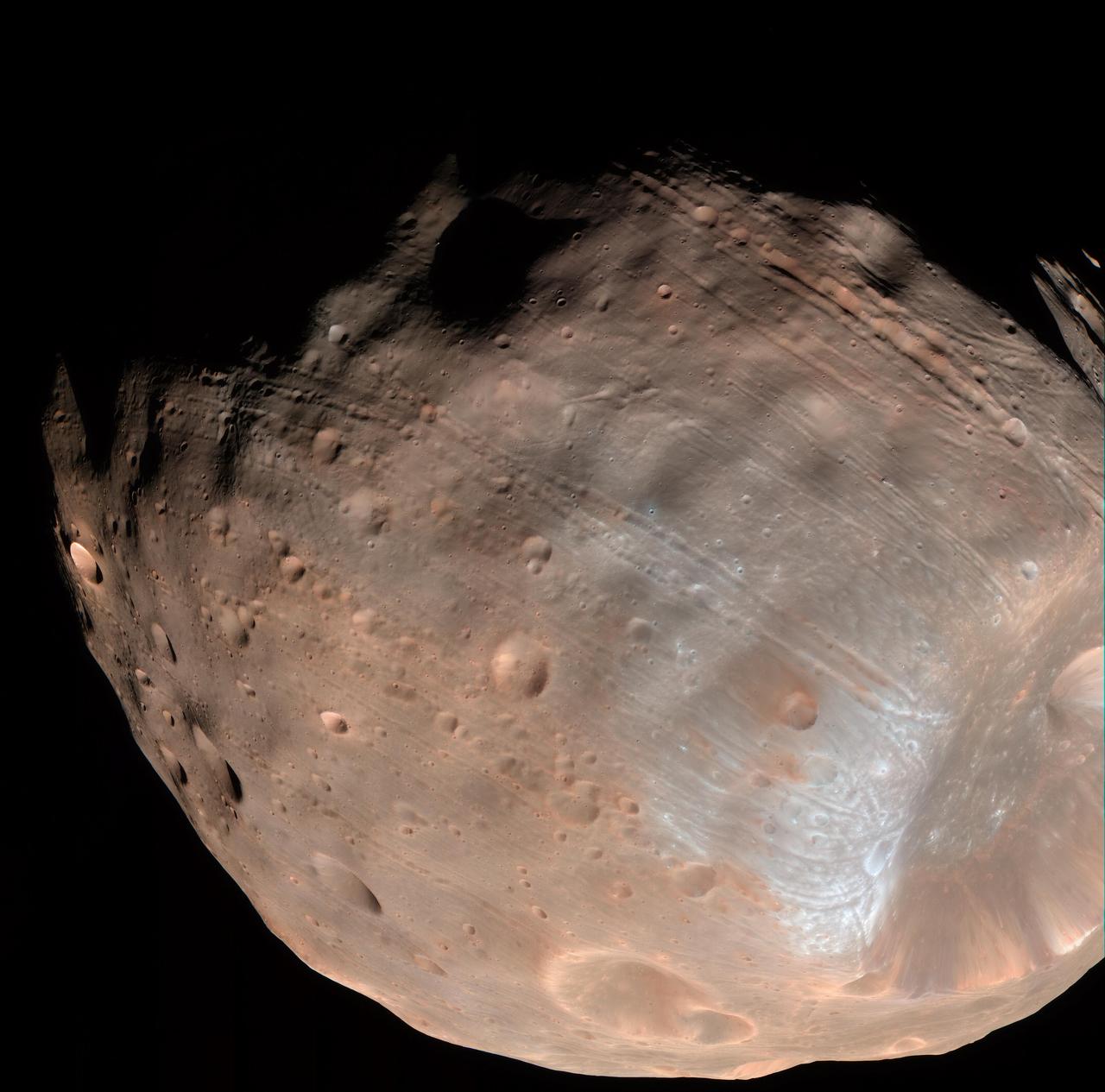
New modeling indicates that the grooves on Mars’ moon Phobos could be produced by tidal forces – the mutual gravitational pull of the planet and the moon. Initially, scientists had thought the grooves were created by the massive impact that made Stickney crater (lower right). Credits: NASA/JPL-Caltech/University of Arizona Read more: go.nasa.gov/1R

SERENDIPITYA little unexpected
FamiliarWeird

New modeling indicates that the grooves on Mars’ moon Phobos could be produced by tidal forces – the mutual gravitational pull of the planet and the moon. Initially, scientists had thought the grooves were created by the massive impact that made Stickney crater (lower right). Credits: NASA/JPL-Caltech/University of Arizona Read more: go.nasa.gov/1RLCS1v NASA image use policy. NASA Goddard Space Flight Center enables NASA’s mission through four scientific endeavors: Earth Science, Heliophysics, Solar System Exploration, and Astrophysics. Goddard plays a leading role in NASA’s accomplishments by contributing compelling scientific knowledge to advance the Agency’s mission. Follow us on Twitter Like us on Facebook Find us on Instagram

Explore NASA's original image record for credits and available downloads.

NASA Image and Video LibraryMars’ Moon Phobos is Slowly Falling Apart

Original explanation based on the sources above. Images carry their own reuse terms.