YOUR NEXT DISCOVERY/SpaceFollow your curiosity
ARC-1979-A79-7107
NASA / ARC · Reuse terms

Space / 1979-07-08

ARC-1979-A79-7107

ARC-1979-A79-7107

NASA's image library records ARC-1979-A79-7107.

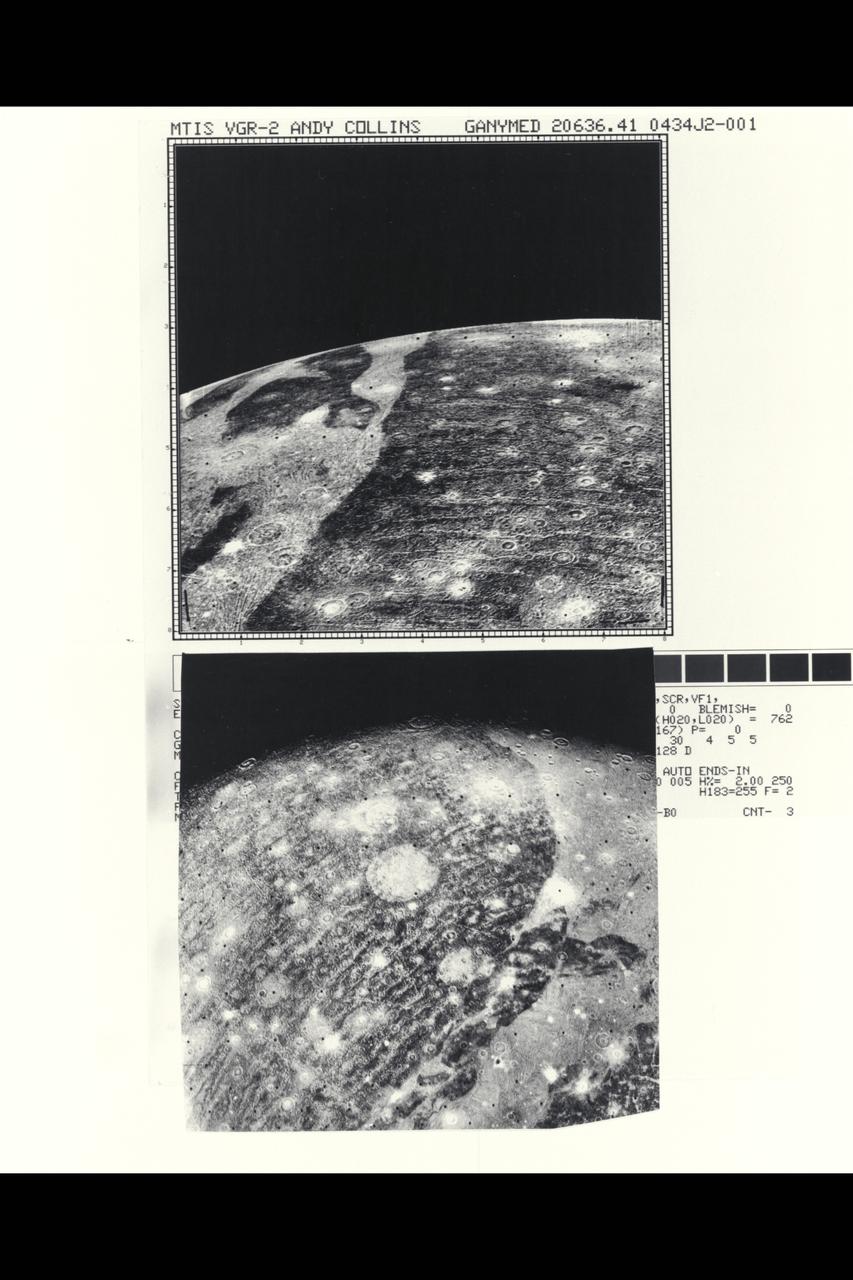
Range : top- 86,000 miles bottom- 192,000 mi. These two close-ups of Ganymede, the largest of Jupiter's 13 moons, show different views of the largest block of dark, heavily cratered terrain. The bottom image shows objects 3 or 4 miles across, with resolution of about 1.5 miles. The light, linear stripes recurring across the dark region resemble the

SERENDIPITYA little unexpected
FamiliarWeird

Range : top- 86,000 miles bottom- 192,000 mi. These two close-ups of Ganymede, the largest of Jupiter's 13 moons, show different views of the largest block of dark, heavily cratered terrain. The bottom image shows objects 3 or 4 miles across, with resolution of about 1.5 miles. The light, linear stripes recurring across the dark region resemble the outer rings of the large ring structure around Callisto. If these features are related to an ancient ring structure formed by a large impact, their small curvature suggests that the original structure was even larger than one seen on Callisto. There is no apparent trace now of the center of this suggested structure, which must have been destroyed by the resurfacing evident over most of Ganymede in the grooved terrain. Another interpretation is t

Explore NASA's original image record for credits and available downloads.

NASA Image and Video LibraryARC-1979-A79-7107

Original explanation based on the sources above. Images carry their own reuse terms.