YOUR NEXT DISCOVERY/SpaceFollow your curiosity
History of Chandra X-Ray Observatory
NASA / MSFC · Reuse terms

Space / 2004-08-23

History of Chandra X-Ray Observatory

History of Chandra X-Ray Observatory

NASA's image library records History of Chandra X-Ray Observatory.

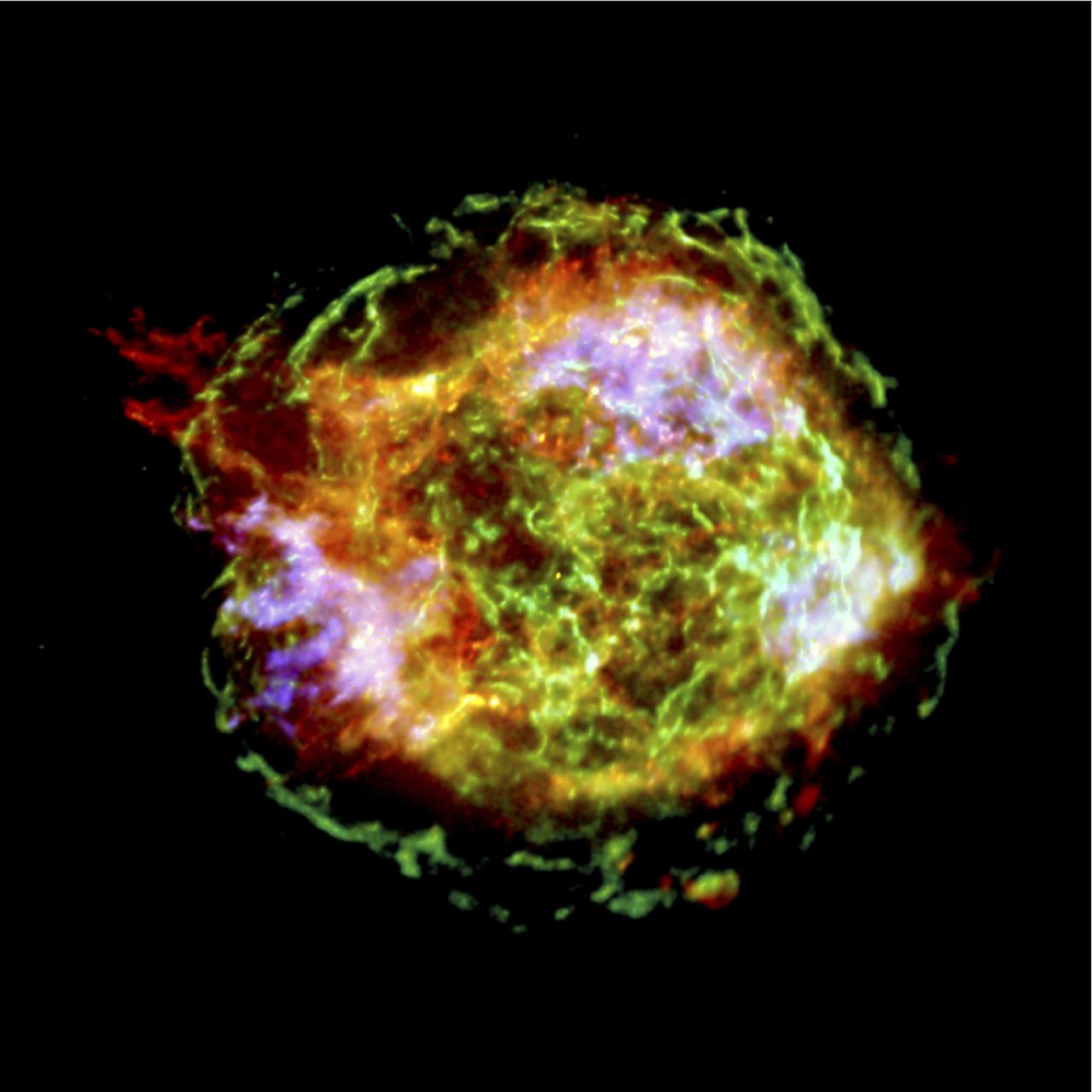
This spectacular Chandra X-Ray Observatory (CXO) image of the supernova remnant Cassiopeia A is the most detailed image ever made of the remains of an exploded star. The one-million-second image shows a bright outer ring (green) 10 light years in diameter that marks the location of a shock wave generated by the supernova explosion. In the upper lef

SERENDIPITYA little unexpected
FamiliarWeird

This spectacular Chandra X-Ray Observatory (CXO) image of the supernova remnant Cassiopeia A is the most detailed image ever made of the remains of an exploded star. The one-million-second image shows a bright outer ring (green) 10 light years in diameter that marks the location of a shock wave generated by the supernova explosion. In the upper left corner is a large jet-like structure that protrudes beyond the shock wave, and a counter-jet can be seen on the lower right. The x-ray spectra show that the jets are rich in silicon atoms, and relatively poor in iron atoms. This indicates that the jets formed soon after the initial explosion of the star, otherwise, the jets should have contained large quantities of iron from the star’s central regions. The bright blue areas are composed almost

Explore NASA's original image record for credits and available downloads.

NASA Image and Video LibraryHistory of Chandra X-Ray Observatory

Original explanation based on the sources above. Images carry their own reuse terms.