YOUR NEXT DISCOVERY/SpaceFollow your curiosity
History of Chandra X-Ray Observatory
NASA / MSFC · Reuse terms

Space / 2000-12-18

History of Chandra X-Ray Observatory

History of Chandra X-Ray Observatory

NASA's image library records History of Chandra X-Ray Observatory.

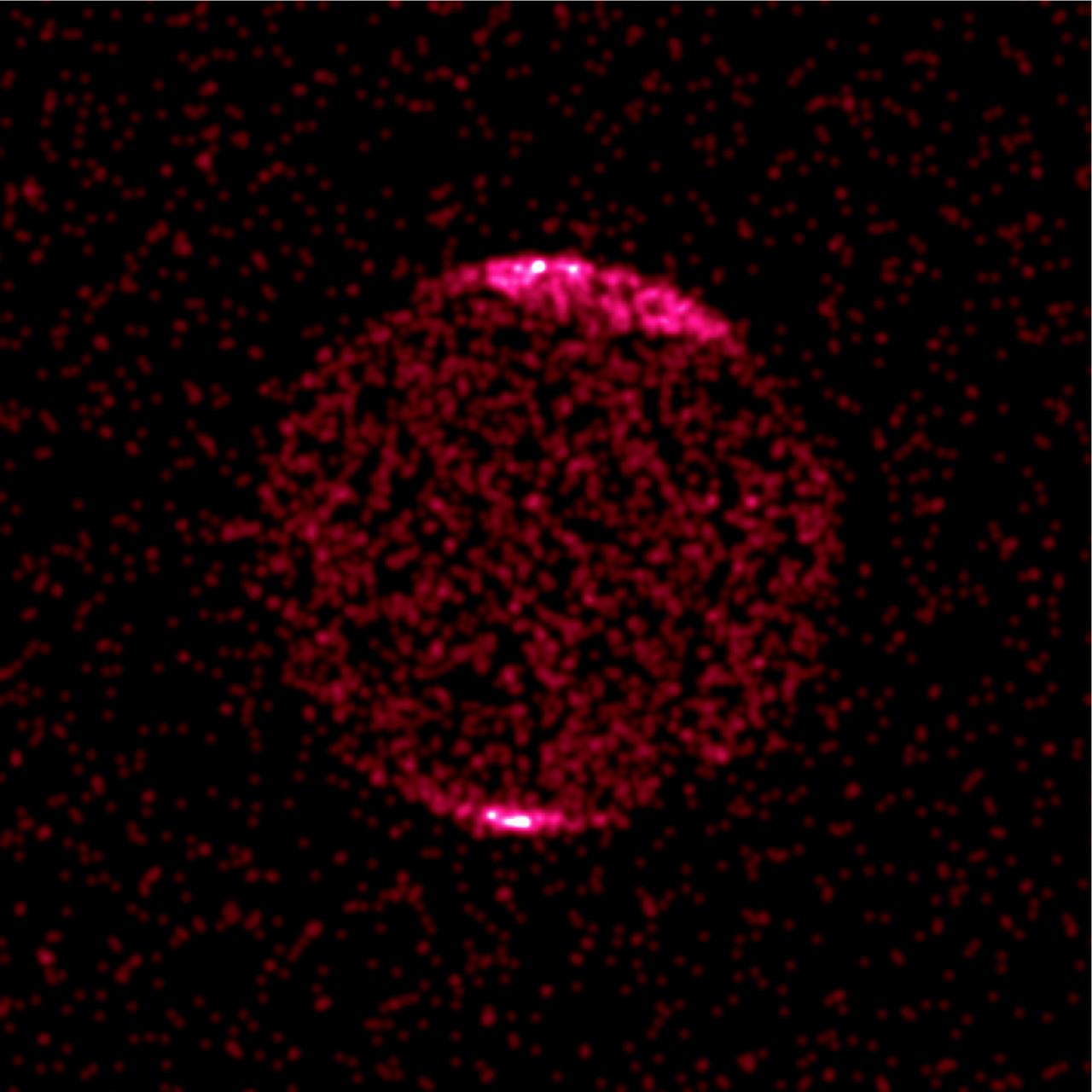
This Chandra image of Jupiter shows concentrations of aurora x-rays near the north and south poles due to a single `hot spot' that pulsates with a period of 45 minutes, similar to high-latitude radio pulsation previously detected by NASA's Galileo and Cassini spacecraft. Previous x-ray detections of Jupiter have been made with other x-ray telescope

SERENDIPITYA little unexpected
FamiliarWeird

This Chandra image of Jupiter shows concentrations of aurora x-rays near the north and south poles due to a single `hot spot' that pulsates with a period of 45 minutes, similar to high-latitude radio pulsation previously detected by NASA's Galileo and Cassini spacecraft. Previous x-ray detections of Jupiter have been made with other x-ray telescopes, but did not reveal that the sources of the x-rays, energetic oxygen and sulfur ions, would be located so near the poles. Previous theories held that ions were mostly coming from Jupiter's moon, lo. Chandra's ability to pinpoint the source of the x-rays discards this theory since ions coming from near lo's orbit carnot reach the observed high latitudes. One possibility is that particles flowing out from the Sun are captured in the outer regions

Explore NASA's original image record for credits and available downloads.

NASA Image and Video LibraryHistory of Chandra X-Ray Observatory

Original explanation based on the sources above. Images carry their own reuse terms.