YOUR NEXT DISCOVERY/SpaceFollow your curiosity
History of Chandra X-Ray Observatory
NASA / MSFC · Reuse terms

Space / 2000-11-01

History of Chandra X-Ray Observatory

History of Chandra X-Ray Observatory

NASA's image library records History of Chandra X-Ray Observatory.

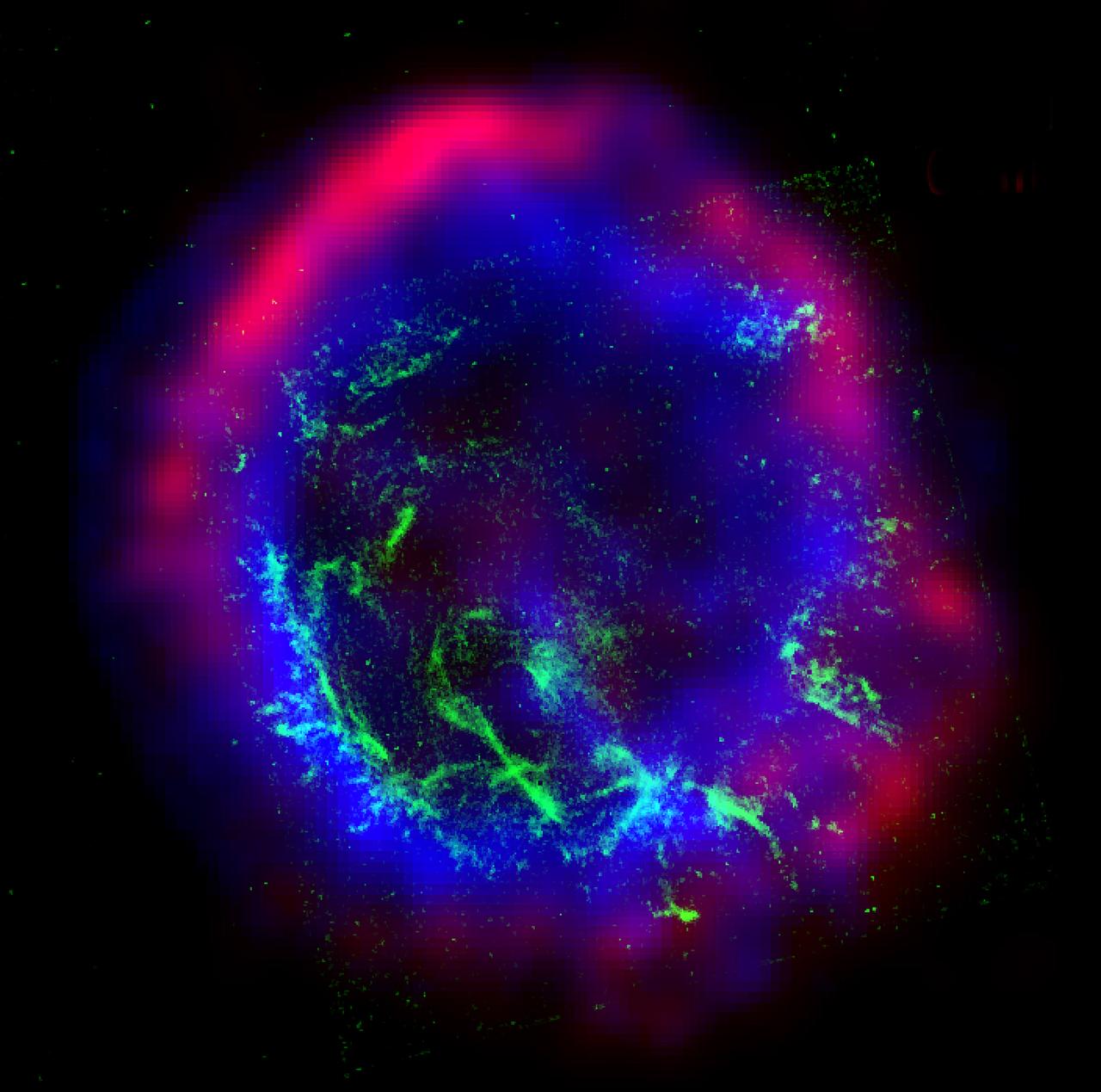
This image is a color composite of the supernova remnant E0102-72: x-ray (blue), optical (green), and radio (red). E0102-72 is the remnant of a star that exploded in a nearby galaxy known as the Small Magellanic Cloud. The star exploded outward at speeds in excess of 20 million kilometers per hour (12 million mph) and collided with surrounding gas.

SERENDIPITYA little unexpected
FamiliarWeird

This image is a color composite of the supernova remnant E0102-72: x-ray (blue), optical (green), and radio (red). E0102-72 is the remnant of a star that exploded in a nearby galaxy known as the Small Magellanic Cloud. The star exploded outward at speeds in excess of 20 million kilometers per hour (12 million mph) and collided with surrounding gas. This collision produced two shock waves, or cosmic sonic booms, one traveling outward, and the other rebounding back into the material ejected by the explosion. The radio image, shown in red, was made using the Australia Telescope Compact Array. The radio waves are due to extremely high-energy electrons spiraling around magnetic field lines in the gas and trace the outward moving shock wave. The Chandra X-ray Observatory image, shown in blue, sh

Explore NASA's original image record for credits and available downloads.

NASA Image and Video LibraryHistory of Chandra X-Ray Observatory

Original explanation based on the sources above. Images carry their own reuse terms.