A CLOSER LOOK
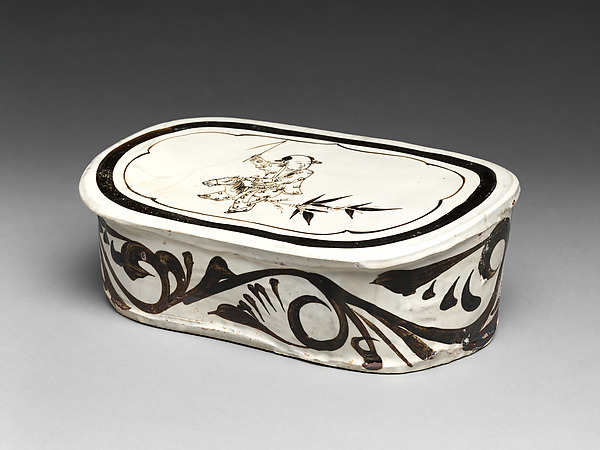
The Met catalogs this pillow as object 60.73.2, made by the Zhang family workshop in China during the Jin dynasty. At 28.6 centimeters long and 10.2 centimeters high, it has a low profile. The museum photograph shows how much of that profile is available for decoration: the top presents a framed scene while the curved side offers a continuous band around the body.
The material description gives a way to read the layers. The Met records brown and black pigment over white slip, all beneath a clear glaze. Slip is a clay-rich coating: here it supplies the light ground visible around the boy and under the dark curves on the side. The catalog calls the object Cizhou ware and identifies the material as stoneware. The white field in the photograph is the prepared surface described in the record.
Follow the heavy outline on the top until it brings your eye back to the rider. Then look over the edge at the large curling marks below. The top invites you to make out a small action inside a border; the bolder side pattern still reads when the top is foreshortened. That is an observation about the photographed object. The entry does not identify its owner or describe how it was positioned in a particular room.
The Met points to hobbyhorse imagery in Chinese art as early as the twelfth century. An image on a dated object gives a useful anchor for the history of the motif. It leaves the earlier history of the toy open: a place and date for a depiction cannot establish the first place someone made or rode a hobbyhorse. The museum offers a possible origin and spread as a hypothesis.