A CLOSER LOOK
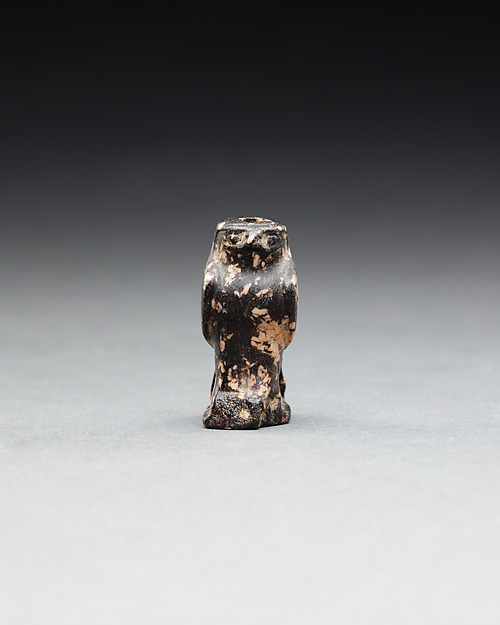
At only three centimeters high, this granodiorite falcon could disappear into a closed hand. Its stocky body rests on a rectangular base. The carver opened a space between the feet and tail, a delicate task at this scale that gives the small bird a surprisingly distinct silhouette.
Two details make the falcon’s earlier appearance intriguing. A hole in the flattened head presumably held a headdress, according to the Met. A groove across the back survives from a pierced loop that has broken away. The proposed headdress remains uncertain; the museum’s description does not identify its shape.
The carved opening beneath the body helps make the surviving form legible, while the broken loop records a lost feature. Together they invite a closer view of how this little object was made and how it has changed. The Met dates it broadly to 664–30 BCE. Nothing in that range supplies the name of its maker or the story of an individual wearer.