YOUR NEXT DISCOVERY/ArtifactsFollow your curiosity
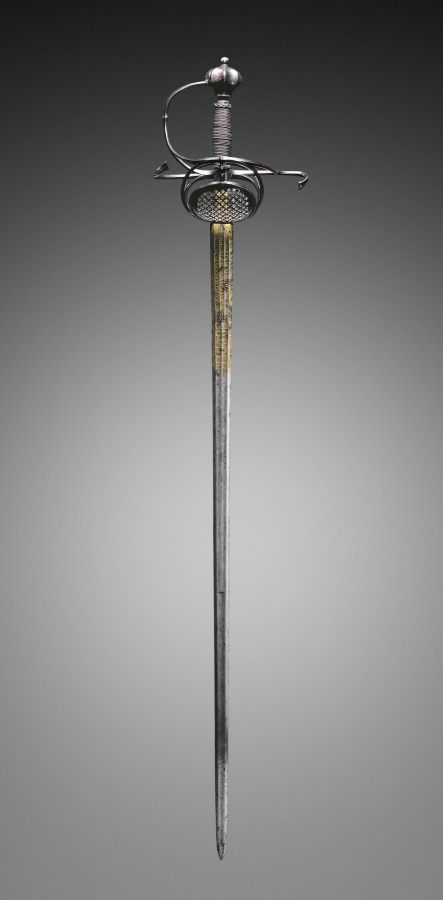
Rapier, from The Cleveland Museum of Art
The Cleveland Museum of Art · Open Access · Reuse terms

Germany, Solingen, 17th century / c. 1620–30

Rapier

Rapier

The Cleveland Museum of Art catalogs Rapier as arms and armor (Germany, Solingen, 17th century · c. 1620–30).

The "Pappenheimer" hilt seen here is named after Count Pappenheimer (1594-1632) who popularized the style which offered more protection to the hand with its large pierced plates.

SERENDIPITYA little unexpected
FamiliarWeird

The museum identifies this arms and armor as steel, blued and gilded and credits Clemens Horn (German, 1586–1617).

The museum's collection notes: This weapon has an especially handsome configuration of hilt, pommel, quillons, and guard. The blade is also very finely wrought and bears the mark (a unicorn head) of the German swordsmith, Clemens Horn, of Solingen, a town near Düsseldorf. The Latin inscription on the blade reads in translation: "Neither without cause, nor fearfully/Between arms and silent law/ Prize truth and the fight for one's country."

The Cleveland Museum of ArtRapier

Original explanation based on the sources above. Images carry their own reuse terms.