YOUR NEXT DISCOVERY/ArtifactsFollow your curiosity
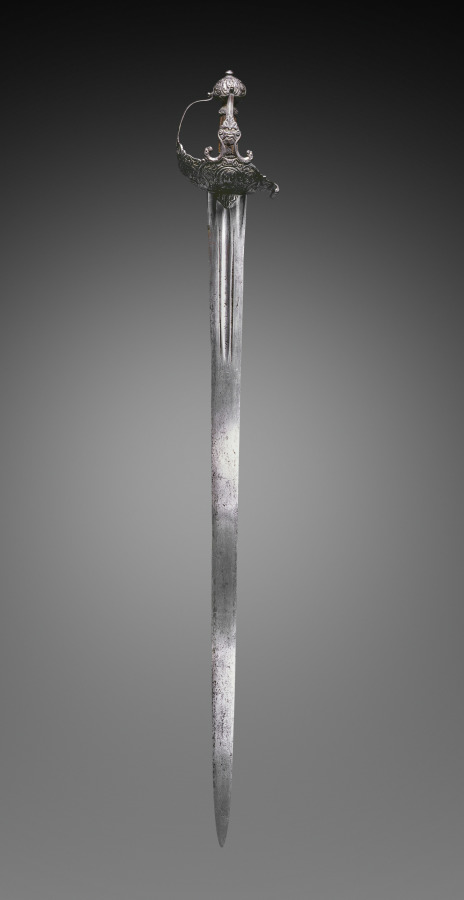
Basket-Hilt Broadsword ("Mortuary Sword"), from The Cleveland Museum of Art
The Cleveland Museum of Art · Open Access · Reuse terms

Hilt: England; Blade: Germany, Solingen (?), Hilt: 17th Century; Blade: 18th Century / hilt: c. 1640–50; blade: 1700s

Basket-Hilt Broadsword ("Mortuary Sword")

Basket-Hilt Broadsword ("Mortuary Sword")

The Cleveland Museum of Art catalogs Basket-Hilt Broadsword ("Mortuary Sword") as arms and armor (Hilt: England; Blade: Germany, Solingen (?), Hilt: 17th Century; Blade: 18th Century · hilt: c. 1640–50; blade: 1700s).

The ornate basket hilt which protects the hand, is chiseled with leafy decorative scrollwork and grotesque masks.

SERENDIPITYA little unexpected
FamiliarWeird

The museum identifies this arms and armor as steel, chiseled; inlaid gilt- silver foil; wood and wire grip.

The museum's collection notes: The decoration on this sword's hilt includes an image of King Charles I of England (beheaded in 1649). Because the image resembles the king's death mask, this sword is known as a "mortuary sword." It may have belonged to Sir Thomas Fairfax, a general of the Parliamentary cavalry during the English Civil War (1642-51). Large, double-edged broadswords, designed for heavy cavalry use, were common from the 1600s through the 1800s.

The Cleveland Museum of ArtBasket-Hilt Broadsword ("Mortuary Sword")

Original explanation based on the sources above. Images carry their own reuse terms.