YOUR NEXT DISCOVERY/ArtifactsFollow your curiosity
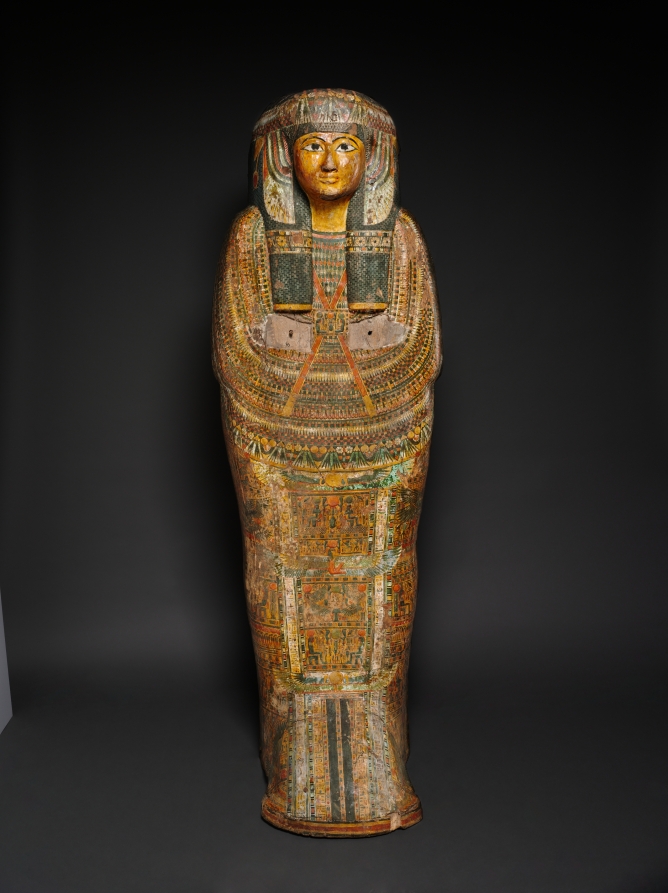
Coffin of Nesykhonsu (lid), from The Cleveland Museum of Art
The Cleveland Museum of Art · Open Access · Reuse terms

Egypt, Third Intermediate (1069–715 BCE), Dynasties 21–22 / c. 976–889 BCE

Coffin of Nesykhonsu (lid)

Coffin of Nesykhonsu (lid)

The Cleveland Museum of Art catalogs Coffin of Nesykhonsu (lid) as funerary equipment (Egypt, Third Intermediate (1069–715 BCE), Dynasties 21–22 · c. 976–889 BCE).

Two of Nesykhonsu's titles, "Lady of the House" and "Singer of the Choir of Mut the Great," are written on the outside of the coffin.

SERENDIPITYA little unexpected
FamiliarWeird

The museum identifies this funerary equipment as gessoed and painted sycamore fig.

The museum's collection notes: A complete set of coffins during the late New Kingdom and Third Intermediate Period consisted of an outer and inner coffin and a mummy board (essentially a lid without a case, placed directly over the wrapped mummy). Judging by its size, this must have been Nesykhonsu's outer coffin. The type is essentially the same as the coffin of Bakenmut, which was also an outer coffin. The two coffins are said to have been found together and to have belonged to a man and wife. This is quite possible, although the inscriptions do not bear it out. Bakenmut is not mentioned on Nesykhonsu's coffin, nor is she mentioned on his. There was by this time a tremen

The Cleveland Museum of ArtCoffin of Nesykhonsu (lid)

Original explanation based on the sources above. Images carry their own reuse terms.