A CLOSER LOOK
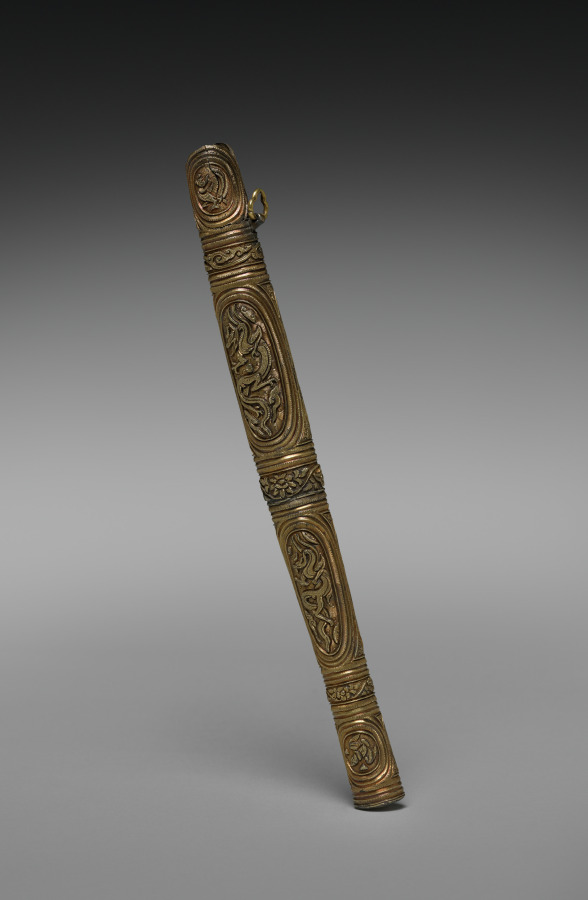
The museum identifies this metalwork as Gilt silver (body) and brass (trefoil-shaped ring).
The museum's collection notes: Made by rolling a flat piece of silver plate, this knife sheath is decorated on each side with oval panels, including two larger middle panels showing an image of rising dragons with ring-punched scales. The circular upper panels bear the image of seated phoenixes. The flat bottom is engraved with a pair of fish, symbolizing harmonious unity. The trefoil-shaped ring attached to the tip of the sheath allows a string to connect it as a pendant to a belt. In medieval Korea, a miniature sheath such as this was considered an important fashion item, especially for elite members of the ruling class.