YOUR NEXT DISCOVERY/ArtifactsFollow your curiosity
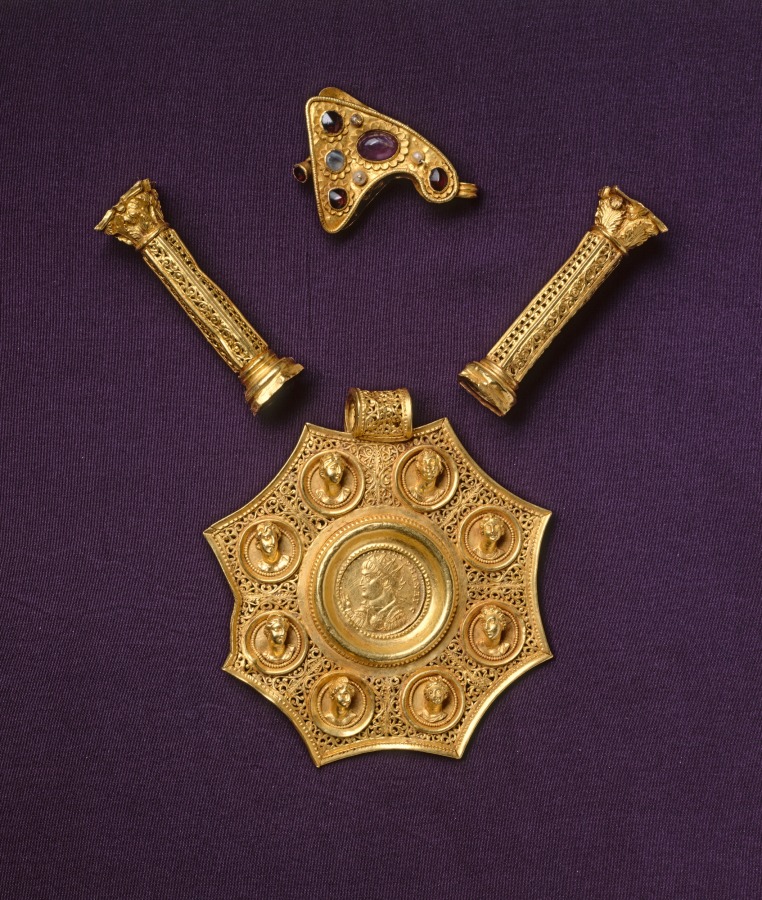
Octagonal Pendant with Corinthian Column Spacers and Clasp Set, from The Cleveland Museum of Art
The Cleveland Museum of Art · Open Access · Reuse terms

Byzantium, Late Roman, Eastern Mediterranean, (probably Sirium or Nicomedia), Byzantine period / 324–26 CE

Octagonal Pendant with Corinthian Column Spacers and Clasp Set

Octagonal Pendant with Corinthian Column Spacers and Clasp Set

The Cleveland Museum of Art catalogs Octagonal Pendant with Corinthian Column Spacers and Clasp Set as jewelry (Byzantium, Late Roman, Eastern Mediterranean, (probably Sirium or Nicomedia), Byzantine period · 324–26 CE).

Using the opus interrasile openwork technique, a goldsmith delicately punched and filed hundreds of tiny holes to create the intricate filigree pattern on this pendant.

SERENDIPITYA little unexpected
FamiliarWeird

The museum identifies this jewelry as gold.

The museum's collection notes: Mounted at the center of this octagonal pendant is a rare coin issued by Constantine the Great, the Roman Empire’s first Christian emperor. Constantine’s portrait appears on the coin’s front, those of two of his sons on the back. Constantine’s image is surrounded by male and female busts, some of which are mythological figures. The pendant once formed the centerpiece of a sumptuous gold necklace, likely a gift for a high-ranking court official or member of the imperial family. This larger necklace is thought to have included four additional coin-set pendants—two hexagonal and two circular, now in Washington, DC (Dumbarton Oaks), London (Briti

The Cleveland Museum of ArtOctagonal Pendant with Corinthian Column Spacers and Clasp Set

Original explanation based on the sources above. Images carry their own reuse terms.