YOUR NEXT DISCOVERY/ArtifactsFollow your curiosity
Hanging with Christian Images, from The Cleveland Museum of Art
The Cleveland Museum of Art · Open Access · Reuse terms

Egypt, Byzantine period / 500s

Hanging with Christian Images

Hanging with Christian Images

The Cleveland Museum of Art catalogs Hanging with Christian Images as textile (Egypt, Byzantine period · 500s).

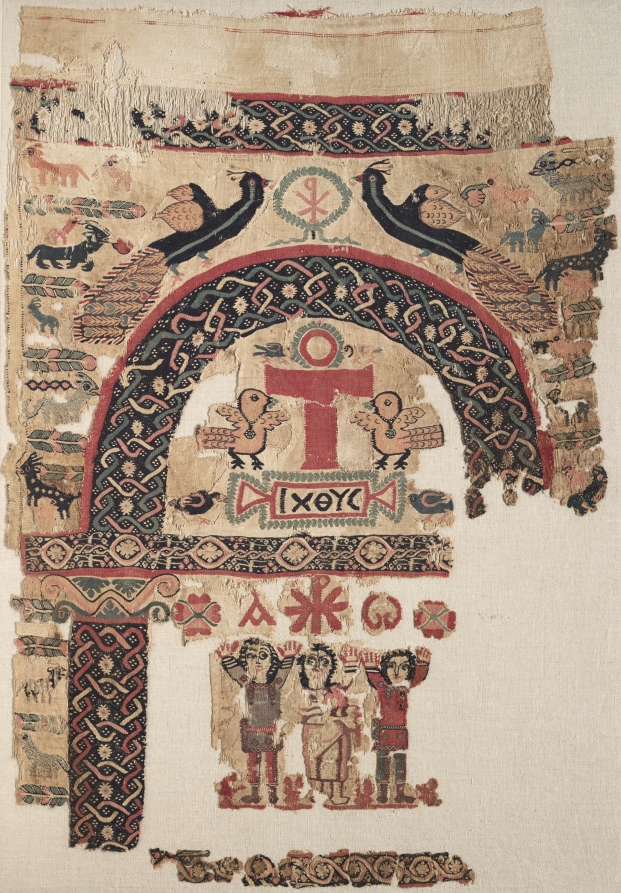
The two peacocks in the upper half of this composition represent immortality. Ancient Greeks and Romans believed that the body of the peacock did not decay after death and when this imagery was adopted by Christianity, the bird came to be associated with resurrection.

SERENDIPITYA little unexpected
FamiliarWeird

The museum identifies this textile as dyed wool, undyed linen: plain weave (tabby) with inwoven tapestry weave.

The museum's collection notes: This rare surviving hanging with Christian symbols likely served as a wall decoration in a church or a home. The three men who stand beneath an arch may represent the three Hebrews who refused to worship a golden idol, and when cast into the fiery furnace, remained unharmed due to God’s deliverance (Daniel 3:19–30). Above them is a Christogram formed by the first two letters of Christ’s name in Greek, X (chi) and P (rho), flanked by the letters for alpha and omega. Beneath the arch, an ankh, an ancient Egyptian symbol of life, is framed by two birds. Another Christogram appears above the arch between two peacocks. The significance of the comb

The Cleveland Museum of ArtHanging with Christian Images

Original explanation based on the sources above. Images carry their own reuse terms.