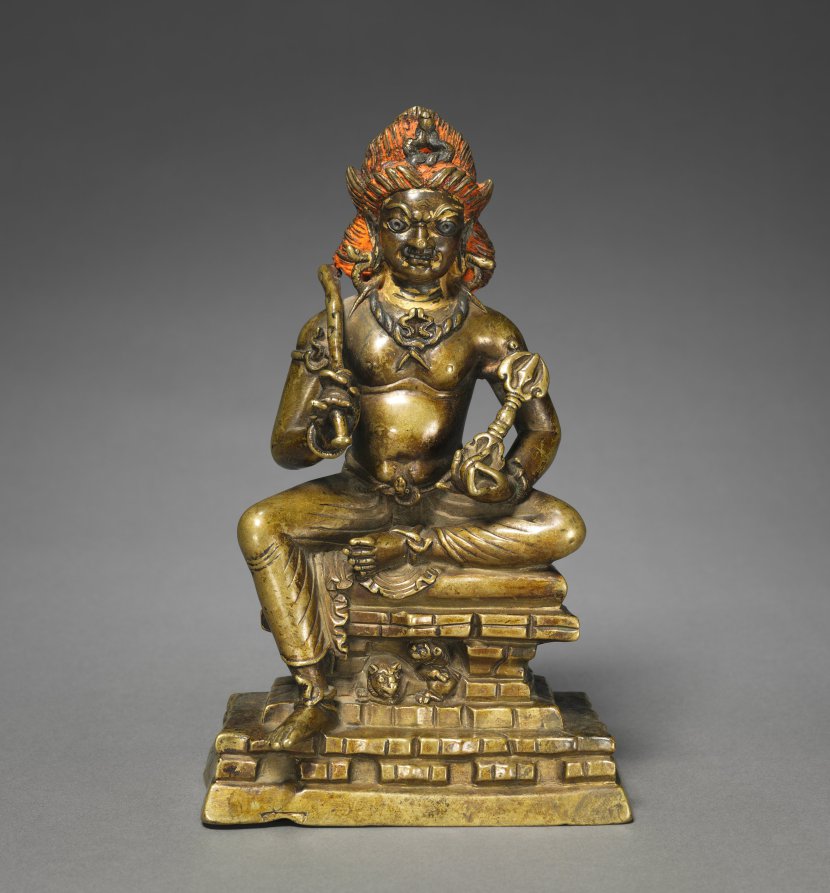
India, Kashmir / 700s
Vajrapani
Vajrapani
The Cleveland Museum of Art catalogs Vajrapani as sculpture (India, Kashmir · 700s).
WHY IT’S INTERESTING
A hole on the back once held a halo behind his head.
India, Kashmir / 700s
Vajrapani
The Cleveland Museum of Art catalogs Vajrapani as sculpture (India, Kashmir · 700s).
A hole on the back once held a halo behind his head.
A CLOSER LOOK
The museum identifies this sculpture as bronze with silver overlay and gum tempera.
The museum's collection notes: The name Vajrapani means “he who holds (pani) the thunderbolt (vajra)” in Sanskrit. Adopted by Buddhists as a protector not only in India and the Himalayan regions of Nepal and Tibet, Vajrapani also was incorporated into art of China, Korea, and Japan. The attributes of the thunderbolt and the club were derived from images of Zeus and Hercules that travelers from the Mediterranean world brought to the region as early as the 320s BC. This rare, early bronze image of Vajrapani visually conveys his power to overcome fear and obstacles to enlightenment, and for this reason he is invoked by Buddhist practitioners. He sits on a pedestal in the form
FOLLOW THE EVIDENCE
The Cleveland Museum of ArtVajrapaniOriginal explanation based on the sources above. Images carry their own reuse terms.