A CLOSER LOOK
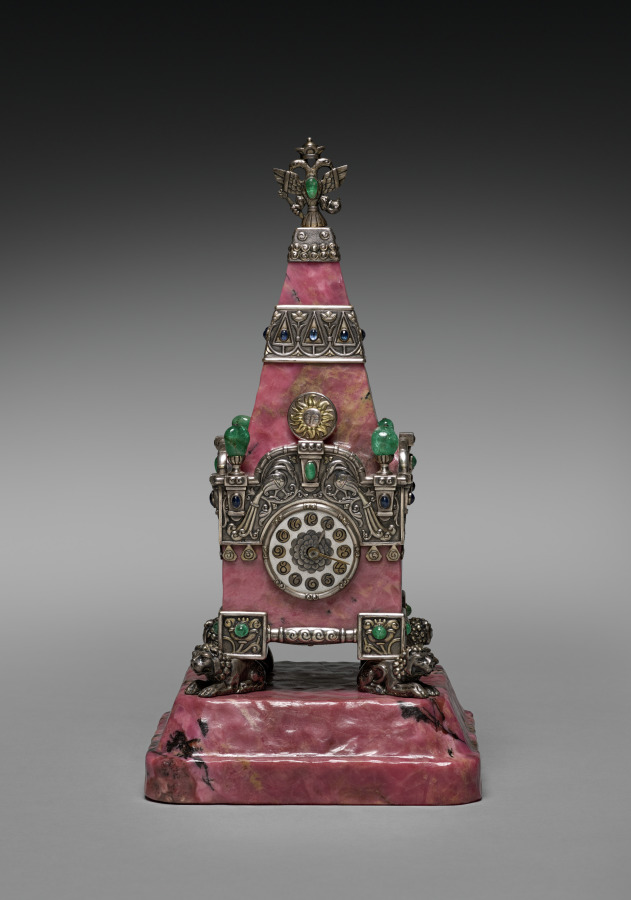
The museum identifies this timepiece as rhodonite, silver, enamel, emeralds, sapphires and credits House of Fabergé (Russian, 1842–1918).
The museum's collection notes: The use of Russian hardstones in creating precious objects became a hallmark of design from the House of Fabergé. Easily carved, these minerals were sourced largely from the western region surrounding the Ural Mountains. Fabergé's workmasters used colorful stones such as agate, nephrite (jade), lapis lazuli, rock crystal, and rhodonite, seen here in this elaborate table or mantel clock, to create all manner of luxurious accessories. Bright pink rhodonite was among the rarest, and consequently most expensive, specimens used by the House of Fabergé. This clock resembles the Taynitskaya Tower, the middle tower on the south side of the Kremlin. T