A CLOSER LOOK
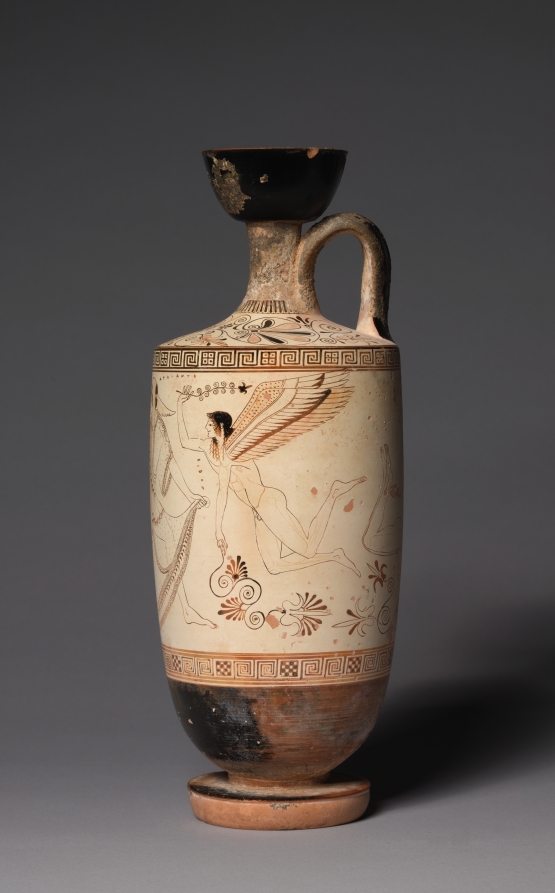
The museum identifies this ceramic as ceramic and credits Douris (Greek, Attic, active c. 500–470 BCE).
The museum's collection notes: Known as "white-ground" because of the white clay slip applied as a surface for figural decoration, vases of this type give some idea of the appearance of lost ancient large-scale wall paintings. Both remarkably well preserved and masterfully composed, the images cover the entire circumference of the vase. At the center, Atalanta, the virgin huntress renowned for both her speed and her opposition to marriage, races to the right while looking back at Eros, the winged god of love; both figures are named. This Eros, bounding forward, tries to crown her, while two additional Erotes (also named) further hem her in. Love will win.