A CLOSER LOOK
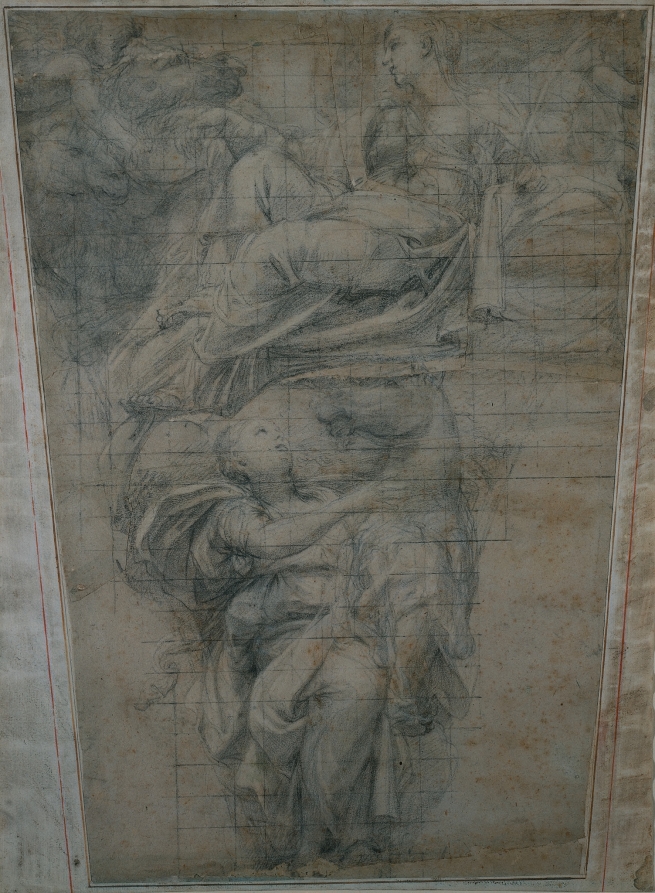
The museum identifies this drawing as black chalk heightened with white chalk, squared with black chalk and credits Domenichino (Italian, 1581–1641).
The museum's collection notes: The gridded pattern superimposed over the figures in this scene indicates that this drawing was used a preparatory study for one of Domenichino’s frescoes depicting the four cardinal virtues inside the dome of the Church of San Carlo ai Catinari in Rome. This technique—called squaring—was a common method used in seventeenth-century Italy to transfer a design from one surface to another. Domenichino prepared the design on three separate sheets of paper, all with irregular edges cut and pasted onto a larger sheet. At the top, the allegorical figure of Temperance, one of four cardinal virtues, reclines gracefully on a cloud. She holds a palm bra