YOUR NEXT DISCOVERY/ArtifactsFollow your curiosity
Dragon and Tiger, from The Cleveland Museum of Art
The Cleveland Museum of Art · Open Access · Reuse terms

Japan, Muromachi period (1392–1573) to Momoyama period (1573–1615) / c. 1546–56

Dragon and Tiger

Dragon and Tiger

The Cleveland Museum of Art catalogs Dragon and Tiger as painting (Japan, Muromachi period (1392–1573) to Momoyama period (1573–1615) · c. 1546–56).

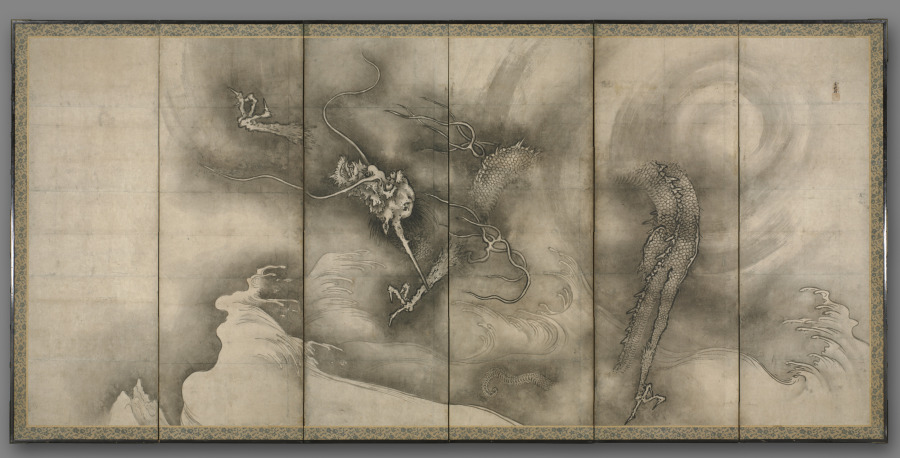
Sesson's dragon, winding in and out of clouds, may have taken inspiration from Chinese Ming-dynasty works in the style of 13th-century Chinese painter Chen Rong.

SERENDIPITYA little unexpected
FamiliarWeird

The museum identifies this painting as One of a pair of six-panel folding screens; ink on paper and credits Sesson Shūkei (Japanese, c. 1492–c. 1577).

The museum's collection notes: In Chinese cosmology, dragons produce rain clouds. The dragon disappearing into and reemerging from clouds in this painting seems to generate rough waves in the water below, pulling it toward the sky. The shape of the foreground wave is indirectly sampled from a painting by 13th-century Chinese painter Yujian, a handscroll once owned by the Ashikaga military rulers of Japan. Sesson must have known the famous painting though copies, and made a copy of his own. Here, the wave reinforces the powerful quality of the dragon.

The Cleveland Museum of ArtDragon and Tiger

Original explanation based on the sources above. Images carry their own reuse terms.