YOUR NEXT DISCOVERY/ArtifactsFollow your curiosity
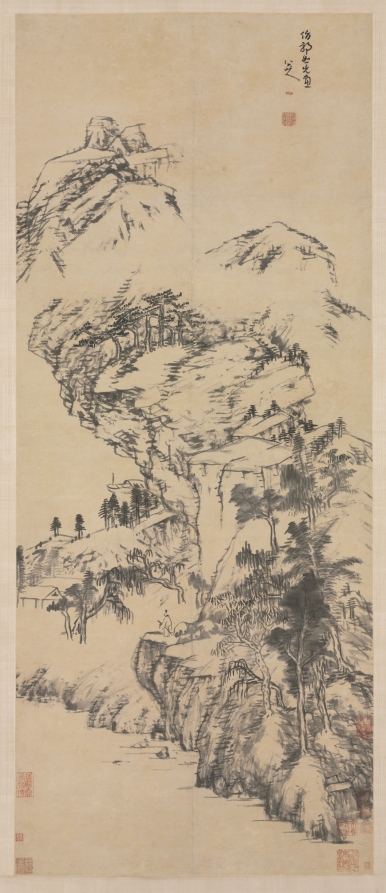
Landscape after Guo Zhongshu, from The Cleveland Museum of Art
The Cleveland Museum of Art · Open Access · Reuse terms

China, Qing dynasty (1644–1911) / c. 1680–1705

Landscape after Guo Zhongshu

Landscape after Guo Zhongshu

The Cleveland Museum of Art catalogs Landscape after Guo Zhongshu as painting (China, Qing dynasty (1644–1911) · c. 1680–1705).

Zhu Da's inscription acknowledges that this painting was done after the early Song master Guo Zhongshu 郭忠恕, but there is almost no tangible stylistic relation to be found between Zhu Da and his 10th-century model.

SERENDIPITYA little unexpected
FamiliarWeird

The museum identifies this painting as Hanging scroll; ink on paper and credits Bada Shanren (Chinese, 1626–1705).

The museum's collection notes: Similar to some calligraphers of his time, Zhu Da rejected conventions in favor of an individual, personal expression. He is known for ambiguous compositions of fish, flowers, birds, and rocks in contrasting ink tonality. As a member of the Ming imperial family, Zhu lost his princely status and hid in a monastery when the Manchus, foreigners from the north, established the Qing dynasty in 1644. In this late work, mountain ranges are rendered in diverse and dense strokes rising toward the top of the scroll. It references the artist Dong Qichang (1555–1636) in concept. Yet the cursory brushwork and composition present Zhu’s personal style.

The Cleveland Museum of ArtLandscape after Guo Zhongshu

Original explanation based on the sources above. Images carry their own reuse terms.