A CLOSER LOOK
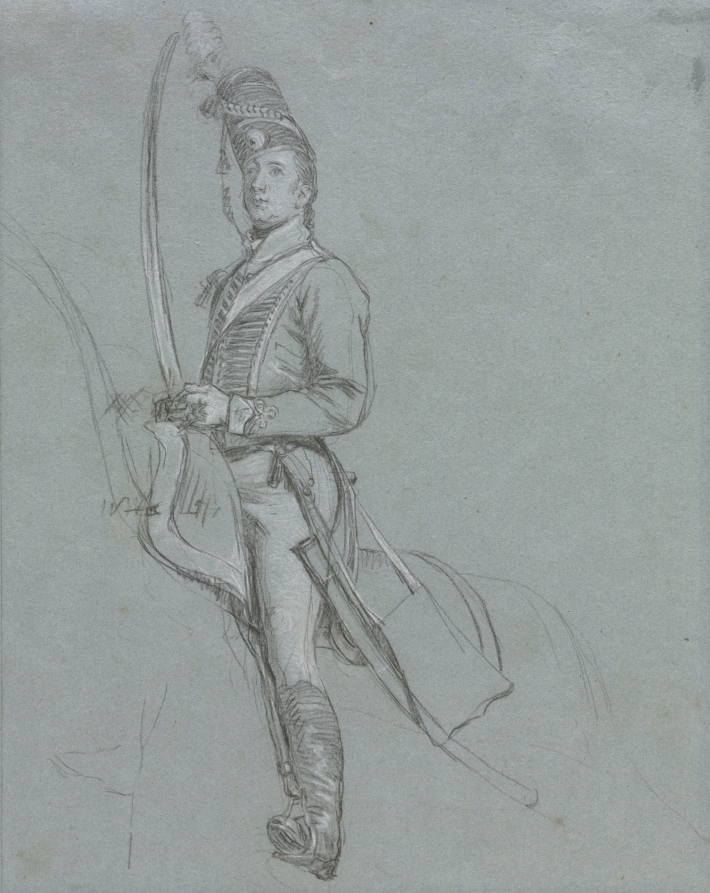
The museum identifies this drawing as black and white chalk and credits John Singleton Copley (American, born The Thirteen Colonies, 1738–1815).
The museum's collection notes: John Singleton Copley left Boston at the start of the American Revolution in 1775 to pursue his career in England, where he achieved distinction both as a portraitist and a history painter. Following a method often employed in France, Copley generally drew on blue paper to serve as a middle tone, working up the image using black chalk to indicate outlines and shadows, and white chalk for highlights. He made this drawing as an early study for the figure of the prince of Orange in his last major history painting, Battle of the Pyrenees (Museum of Fine Arts, Boston), in 1812–15. The figure is garbed in the uniform of a “hussar,” a light cavalry