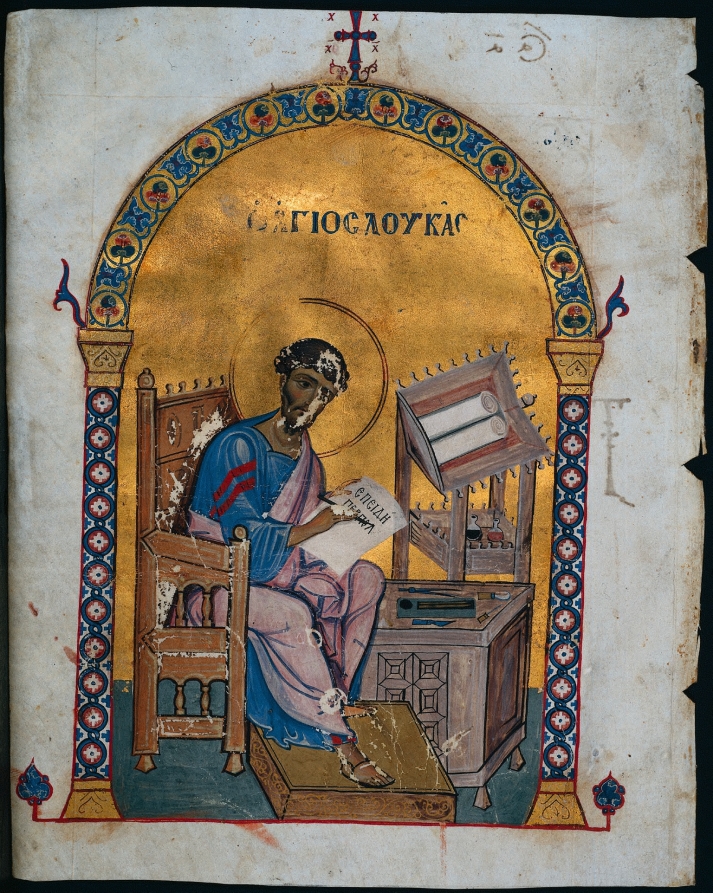
A CLOSER LOOK
The museum identifies this manuscript as ink, tempera and gold on vellum.
The museum's collection notes: These leaves are from a lectionary (a book of gospel readings used in church services) that was presented to the Holy Trinity Monastery at Chalke in Constantinople by the Empress Katherine Komnene in 1063. The tools of the scribe’s trade are laid out before the evangelists: a stylus (a pointed tool for writing, drawing, and engraving), a pair of dividers (a device resembling a compass, used for dividing lines and transferring measurements), pens, a knife, a burnisher (polishing tool), and inkpots. Portraits of the authors of the Gospels—Matthew, Mark, Luke, and John—appear frequently in gospel books throughout the Christian world. Understood