Greece / 400–350 BCE
Grave Stele
Grave Stele
The Cleveland Museum of Art catalogs Grave Stele as sculpture (Greece · 400–350 BCE).
WHY IT’S INTERESTING
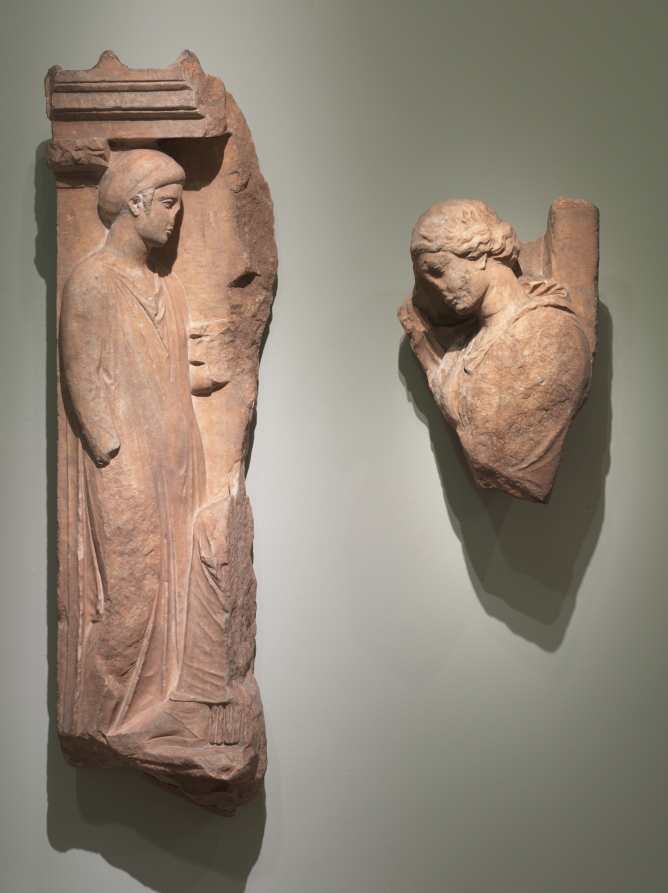
The fragmentary seated woman at right represents the deceased.
Greece / 400–350 BCE
Grave Stele
The Cleveland Museum of Art catalogs Grave Stele as sculpture (Greece · 400–350 BCE).
The fragmentary seated woman at right represents the deceased.
A CLOSER LOOK
The museum identifies this sculpture as pentelic marble.
The museum's collection notes: Carved in high relief, the original composition of this Attic grave marker can be reconstructed by comparison with more complete examples elsewhere (such as the Stele of Hegeso in Athens [National Archaeological Museum, 3624]). The standing figure at left likely represents a maid or servant, her hair mostly contained within a sakkos (haircloth). Holding a pyxis (small container) in her left hand, she approaches the more fragmentary seated figure at right. This woman, draped and casting her eyes downward, represents the deceased, perhaps Phanostrate, as one scholar has restored the partial name Phan... inscribed in the fragmentary epigram on t
FOLLOW THE EVIDENCE
The Cleveland Museum of ArtGrave SteleOriginal explanation based on the sources above. Images carry their own reuse terms.