A CLOSER LOOK
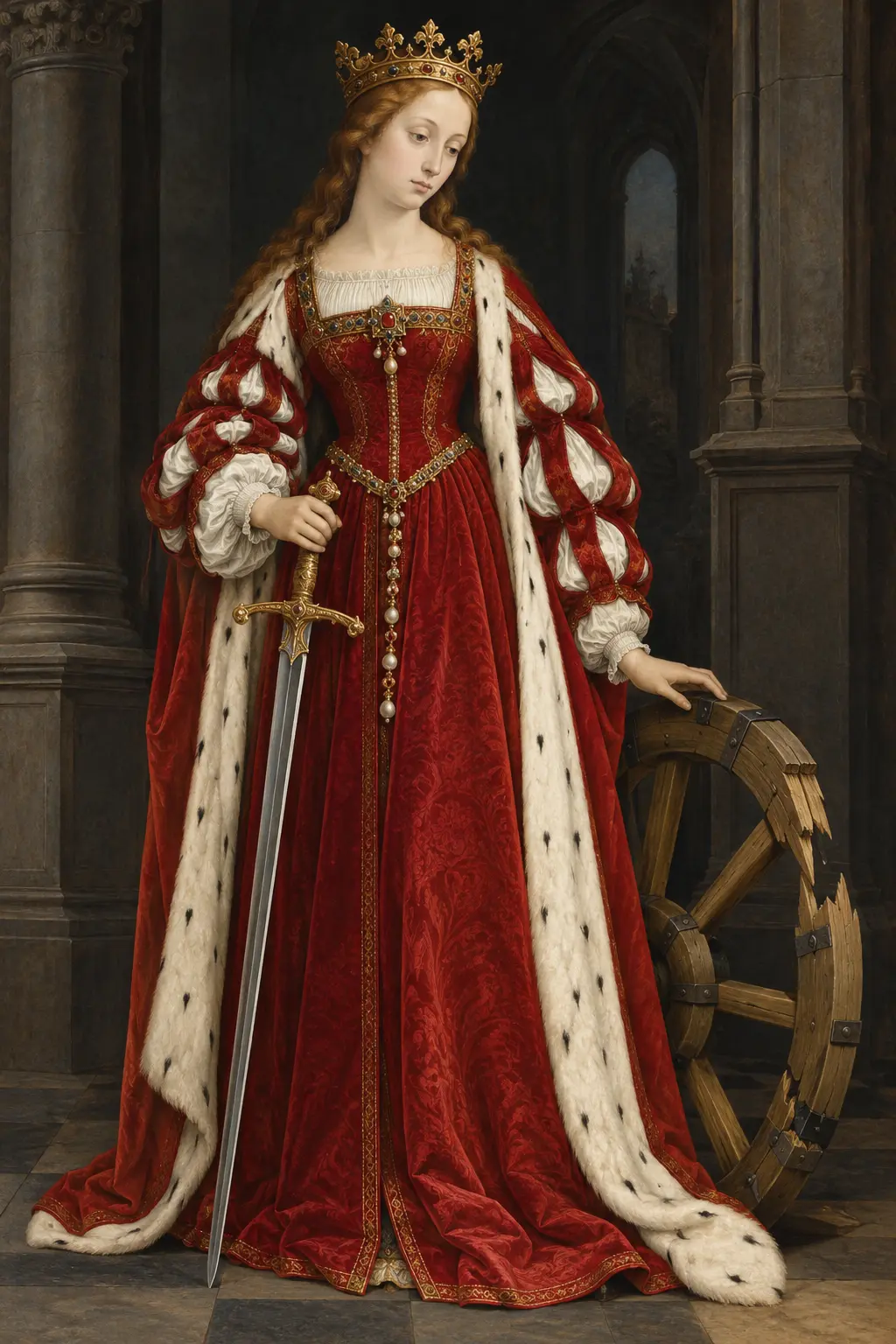
The Art Institute dates this oil-on-panel painting to about 1520 and attributes it to Jean Bellegambe, who worked in Douai. The narrow panel measures 82.5 by 28.1 centimetres. Its tall proportions suit a standing figure and also hint that it once belonged within a larger ensemble rather than functioning as an isolated portrait.
Catherine is identified by a sword and the wheel on which, according to her legend, she was tortured. These are attributes: recognizable objects that helped viewers distinguish saints without relying on a written label. The painting turns instruments of suffering into a compact visual biography.
Bellegambe placed the ancient saint in luxury clothing from his own period. Slits at the forearms reveal puffs of fine white linen. A crown decorated with fleurs-de-lis and a red cape lined with spotted ermine evoke fashions associated with sixteenth-century French monarchy. The costume makes her legendary status as a princess visible through contemporary signs of privilege.
The museum discusses this panel alongside Saint Barbara, a companion of almost identical height and width. Their shared scale, date, artist, collection history, and linked catalog description make comparison essential: each woman is differentiated by her attribute, pose, and clothing while the pair maintains a common devotional register.
The public record traces the panel to Achillito Chiesa by 1925, then to George F. Harding and the Harding Museum before its transfer to the Art Institute and accession in 1983. That modern provenance does not reconstruct the painting’s original church setting or the complete altarpiece. Interpretations of its first placement should therefore remain provisional.