A CLOSER LOOK
The museum credits Robert van Voerst as the engraver and identifies Anthony van Dyck as the artist whose work he followed. Simon Vouet is the portrait’s subject. Reading those roles separately helps explain how one image can carry the names of several artists.
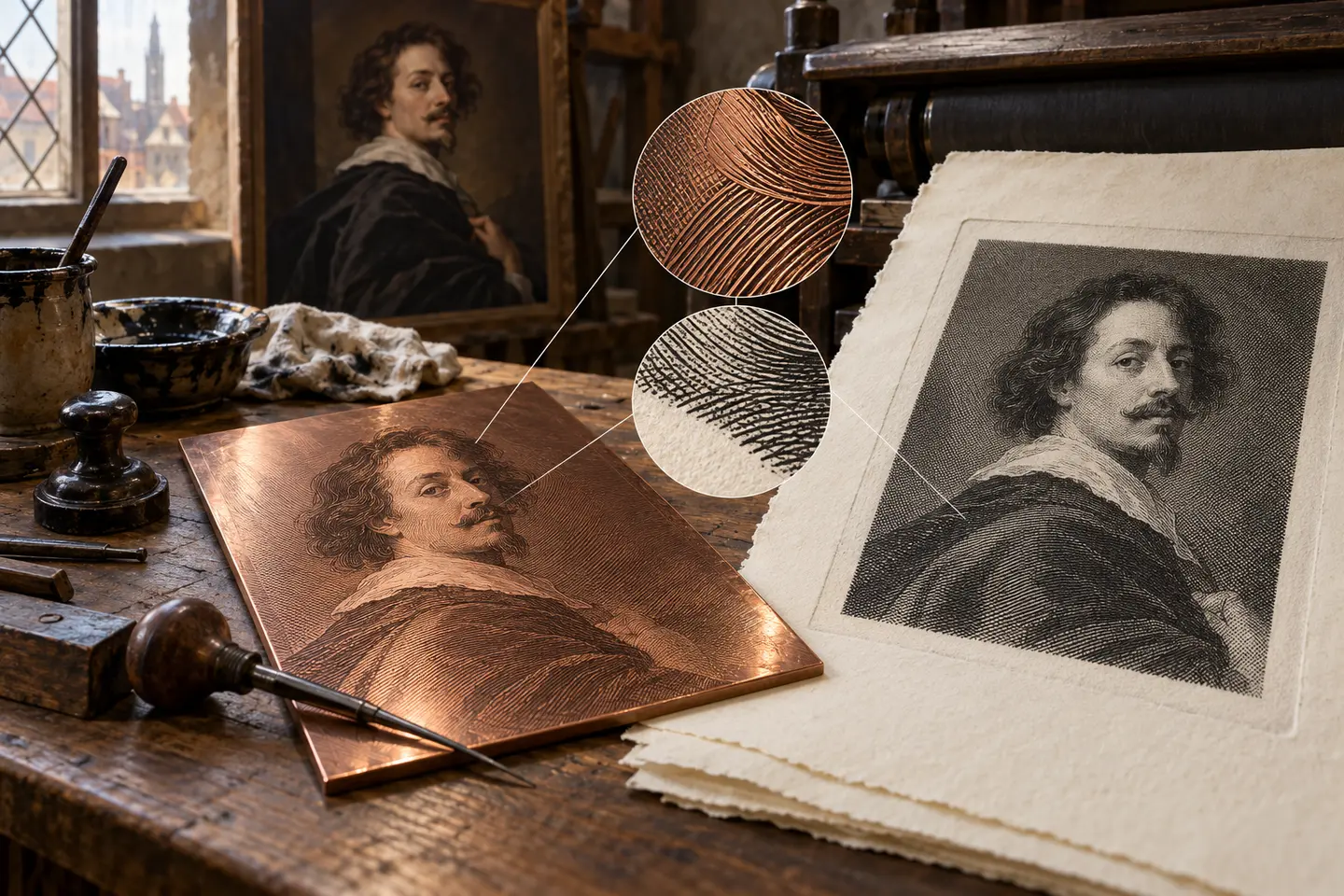
Engraving begins with a polished metal plate. A burin cuts grooves that hold ink after the surface is wiped. Pressure from a press drives damp paper into the recesses, transferring the ink and reversing the plate’s composition. The Met’s explanation describes this general process; the Chicago record does not identify this particular plate’s metal.
An engraver can vary the width of a cut through the tool and the pressure applied. Closely spaced marks create darker passages. Looking at an enlarged reproduction offers a way to follow how separate lines build the appearance of a face and clothing. Those marks preserve decisions made while translating a model into a printable surface.
Chicago records this sheet as trimmed to the platemark, measuring 24.3 by 17.7 centimetres. A platemark is the outline impressed into paper by the plate’s edges under pressure. The trimming description therefore connects the object’s present dimensions to the machinery that produced the impression.
The accession number is 1887.716, and the credit line records a gift from John E. Irwin. The museum marks the image public domain. Its brief record supplies no narrative description or account of this impression’s earlier ownership, so the page leaves those questions open. Screen viewing also gives limited access to the paper’s physical texture.